
A water-wise butterfly garden for hot Southwest yards that want pollinators, seasonal color, and a little dignity after July has tried to turn everything into toast.
This is a Landscapade reference design for low-desert and hot arid gardens. It is written for homeowner planning, not as site-specific horticultural advice. Before installing it, confirm plant choices, water rules, mature sizes, and substitutions with qualified local guidance.
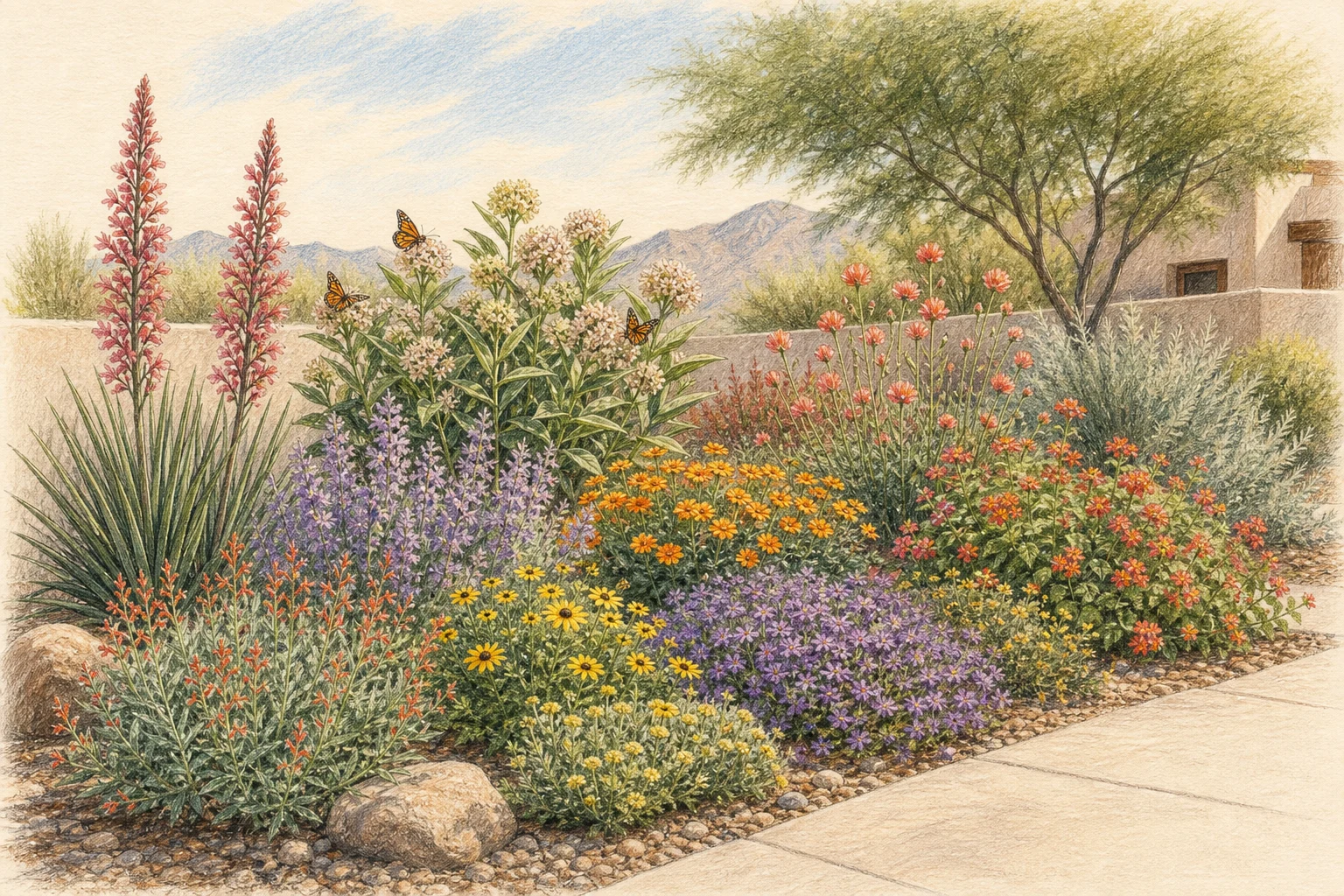
Plan Snapshot
- Garden type: Butterfly Garden
- Region: American Southwest low desert and hot arid gardens
- Best suited to: Phoenix, Scottsdale, Tucson, Las Vegas, Palm Springs, inland Southern California valleys, and similar hot arid Zone 9/10 conditions
- Example size: approximately 12 by 18 feet
- Exposure: full sun to light afternoon-filtered shade in the harshest reflected-heat sites
- Water strategy: drip-irrigated establishment, then lower-water care by hydrozone
- Design posture: retail-friendly primary palette with more regional specialty alternates
- Best use: a front-yard border, backyard pollinator bed, or sunny side-yard feature with enough room for layered planting
The Big Idea
A butterfly garden in the Southwest cannot just be a tray of cheerful flowers with a dream. Heat, reflected light, alkaline soil, dry wind, and irrigation reality all get a vote. Sometimes they vote loudly.
This plan starts with a practical low-desert structure: tough flowering shrubs, host plants, nectar masses, and dry-edge plants that can look intentional instead of abandoned. The goal is not a fussy botanical collector's bed. It is a readable, homeowner-scale pollinator garden with enough repetition to look designed and enough caveats to avoid expensive plant drama.
The layout uses three simple layers:
- A rear structural layer for height and year-round form.
- A middle pollinator layer for host plants and concentrated bloom.
- A dry foreground edge for low plants that prefer sharper drainage and less pampering.
That structure matters. Without it, a butterfly garden can become a plant yard sale: technically full of plants, emotionally full of regret.
Where This Plan Works Best
Use this plan where the garden gets at least six hours of sun, has drip irrigation available for establishment, and has enough space for plants to mature without mugging the sidewalk.
It works best in:
- Sunny front-yard or backyard borders.
- Low-desert residential gardens where water-wise planting is expected.
- Beds with a wall, fence, or taller backdrop behind them.
- Sites where seasonal bloom and temporary roughness are acceptable.
- Areas away from frequent pesticide drift.
It may need adaptation in:
- High-elevation Southwest gardens with colder winters.
- Coastal Southern California gardens with cooler marine influence.
- Narrow strips next to pavement, block walls, driveways, or other heat mirrors.
- Heavy clay, caliche, salty soil, or poor-drainage sites.
- Yards where everything must look clipped, evergreen, and HOA-handbook cheerful every day of the year.
Before You Buy Plants
Walk the site before you shop. This sounds obvious, which is why it is so often skipped by people later holding three shrubs and a receipt that feels accusatory.
Check:
- How much sun the bed gets in summer.
- Where reflected heat hits from walls, windows, pavement, or gravel.
- Whether water drains or sits after irrigation.
- Where drip lines can realistically run.
- Mature plant widths near walks, utility boxes, walls, and gates.
- Local plant availability and any municipal or HOA restrictions.
The plan is drawn around a 12-by-18-foot example bed. You can mirror it or adapt the proportions, but keep the logic: tall and structural toward the back, pollinator activity through the middle, dry lower plants toward the front edge.
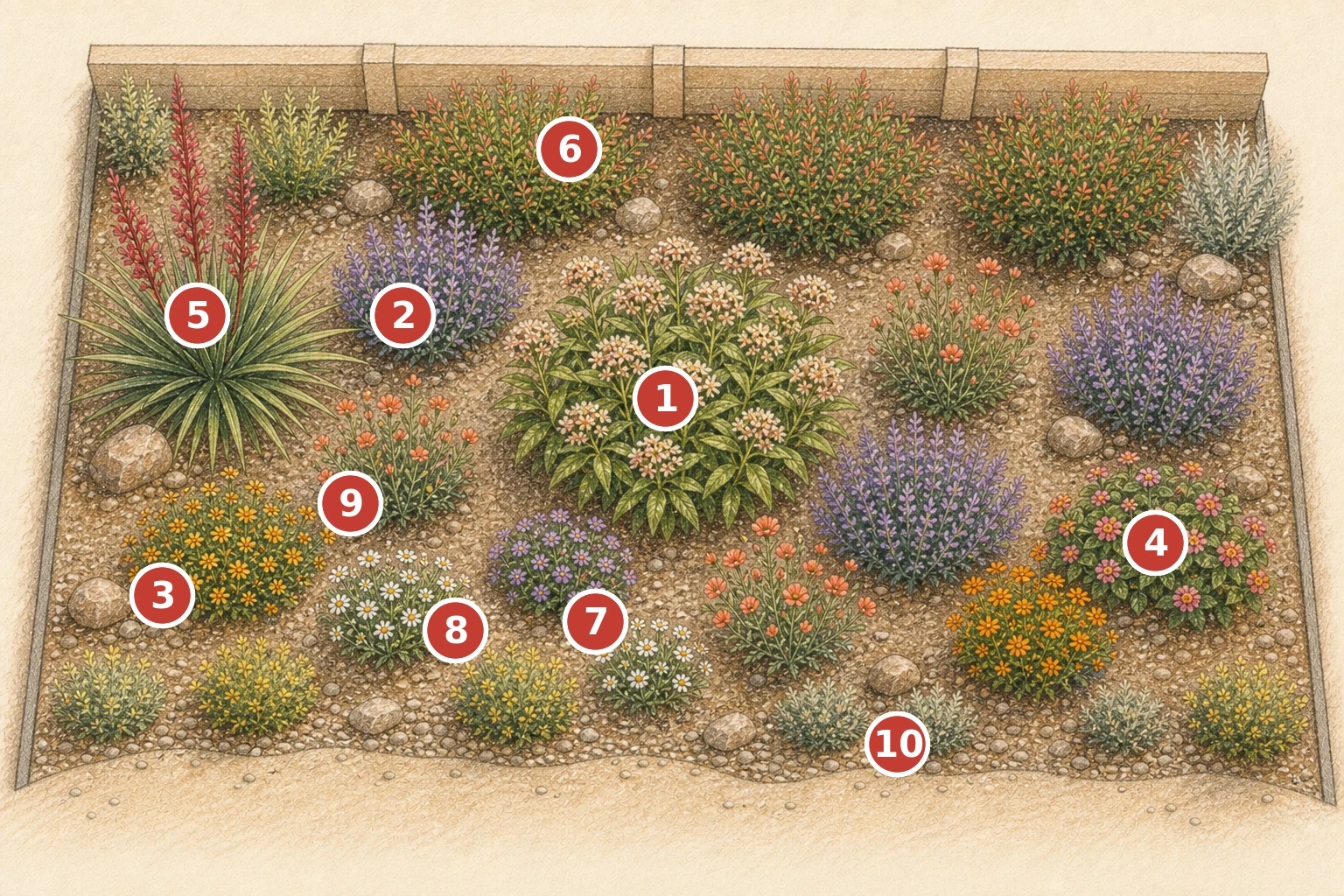
Primary Plant Palette
This palette leads with plants a homeowner has a reasonable chance of finding through common nurseries, local water-wise sources, or native plant nurseries. Retail availability is a useful signal. It is not a magical certificate of regional fitness.
Treat this plant palette as a planning palette that still deserves regional validation before installation, not a final nursery shopping commandment delivered from a tasteful desert cloud.
| No. | Quantity | Common name | Botanical name | Role | Hydrozone | Notes |
|---|---|---|---|---|---|---|
| 1 | 3 | Desert milkweed | Asclepias subulata | Host plant and upright low-desert accent | 1 | Keep as the host-plant anchor. May require a native plant nursery and may be sold as rush milkweed. |
| 2 | 5 | Autumn sage | Salvia greggii | Nectar shrub/perennial | 1 | Use heat-tolerant selections. Give light afternoon shade in brutal reflected-heat pockets. |
| 3 | 7 | Desert marigold | Baileya multiradiata | Very-low-water flowering filler | 3 | Long-blooming and desert-adapted. Short-lived or reseeding behavior is seasonal character, not necessarily failure. |
| 4 | 5 | Trailing lantana | Lantana montevidensis | Flowering groundcover and nectar support | 1 | Practical availability plant, not the ecological centerpiece. Verify local guidance. |
| 5 | 3 | Red yucca | Hesperaloe parviflora | Evergreen accent and flower spike | 3 | Durable structure. More architecture and hummingbird value than butterfly-host value. |
| 6 | 3 | Baja fairy duster | Calliandra californica | Flowering shrub backbone | 2 | Use toward the back or corners. Leave room for airy mature spread. |
| 7 | 5 | Nursery verbena | Verbena or Glandularia hybrids | Flowering edge or temporary nectar color | 1 | Useful when Goodding's verbena is unavailable. Do not treat generic verbena as the same ecological choice. |
| 8 | 5 | Blackfoot daisy | Melampodium leucanthum | Low dry-edge flower | 3 | Best in well-drained foreground areas. It is not asking for spa-day irrigation. |
| 9 | 3 | Globe mallow | Sphaeralcea ambigua | Seasonal color and desert texture | 2 | Great Southwest color. Keep away from tight path edges if local sources flag irritation concerns. |
| 10 | 5 | Damianita | Chrysactinia mexicana | Low-water aromatic edge mound | 3 | Slow, durable, and useful for dry-edge texture. Not instant bedding-plant gratification. |
Plant Vignette Legend
The plant vignette sheet is support art, not a botanical field guide. It should help you compare forms, habits, and planting roles before you shop. It should not be used to identify plants in the wild, settle nursery substitutions, or win an argument with someone holding a clipboard.
Use the numbers on the vignette art with the legend below. The key idea is role first, plant second. If a plant changes after local review, replace the job it was doing in the garden rather than chasing a matching flower color.
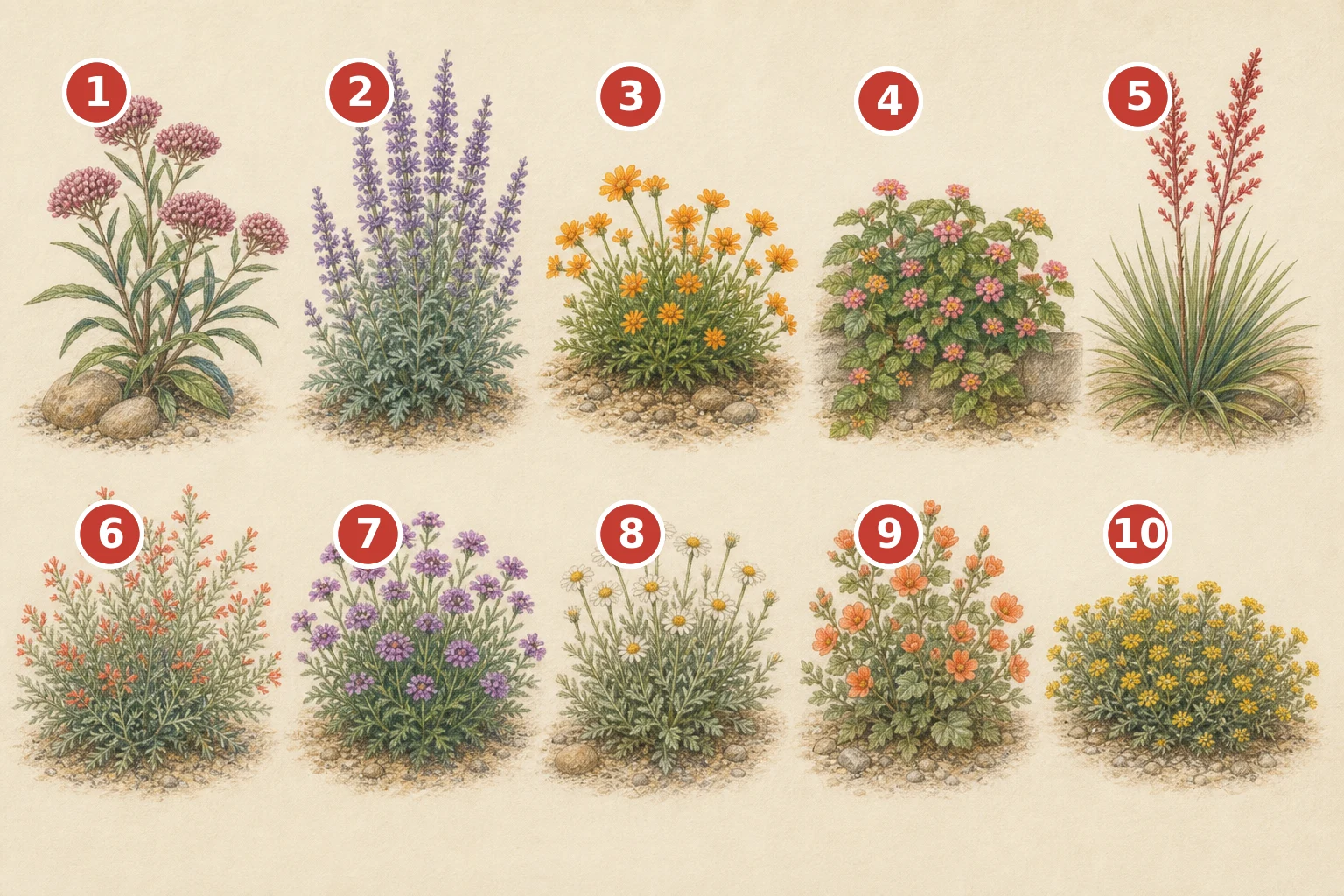
| No. | Plant | Botanical name | Comments | Hydrozone / watering posture | Replacement / substitution |
|---|---|---|---|---|---|
| 1 | Desert milkweed | Asclepias subulata | Host-plant anchor and upright low-desert accent. This is the ecological job the plan cannot casually lose. | Hydrozone 1. More consistent establishment water, then adjust by local guidance. | Narrowleaf milkweed, Asclepias fascicularis, only where local guidance supports it. |
| 2 | Autumn sage | Salvia greggii | Repeated nectar shrub/perennial for bloom rhythm and color. Use heat-tolerant selections. | Hydrozone 1. Moderate establishment and bloom support, especially in harsh exposure. | Parry's penstemon for spring vertical bloom, or another locally appropriate salvia. |
| 3 | Desert marigold | Baileya multiradiata | Very-low-water flowering filler for sunny foreground pockets. Seasonal looseness is part of the deal. | Hydrozone 3. Dry-edge posture after establishment. | Desert zinnia where locally appropriate and available. |
| 4 | Trailing lantana | Lantana montevidensis | Practical nectar and groundcover support. Helpful, available, and not the main ecological hero. | Hydrozone 1. Moderate bloom support; verify local use and spread. | Goodding's verbena or another locally appropriate low nectar groundcover. |
| 5 | Red yucca | Hesperaloe parviflora | Evergreen structure, flower spikes, and desert architecture. Less butterfly host, more backbone. | Hydrozone 3. Low-water structural plant after establishment. | Locally appropriate hesperaloe or agave-like accent where path safety and mature size work. |
| 6 | Baja fairy duster | Calliandra californica | Flowering shrub backbone for the rear layer. Give it room to be airy, not wedged. | Hydrozone 2. Low-water shrub rhythm after establishment. | Desert lavender where there is enough room, or another locally appropriate flowering desert shrub. |
| 7 | Nursery verbena | Verbena or Glandularia hybrids | Available edge or middle bloom color when specialty natives are hard to source. | Hydrozone 1. More consistent bloom support than the dry-edge plants. | Goodding's verbena if available and locally appropriate. |
| 8 | Blackfoot daisy | Melampodium leucanthum | Low dry-edge flower for texture and front-of-bed softness. It prefers drainage over pampering. | Hydrozone 3. Very-low-water foreground posture after establishment. | Desert zinnia or another locally appropriate low dry-edge perennial. |
| 9 | Globe mallow | Sphaeralcea ambigua | Seasonal desert color and loose texture. Keep it where a little wildness is welcome. | Hydrozone 2. Low-water middle-layer plant after establishment. | Parry's penstemon or another locally appropriate seasonal bloom plant. |
| 10 | Damianita | Chrysactinia mexicana | Aromatic dry-edge mound for durable texture and small-scale repetition. | Hydrozone 3. Very-low-water edge plant after establishment. | Desert zinnia or blackfoot daisy where local guidance supports the swap. |
Specialty Alternates
Use alternates by role, not impulse. A plant can be more interesting and still be the wrong answer for a particular yard. This is gardening, not fantasy football.
| Code | Quantity | Alternate | Use instead of | Why consider it | Caveat |
|---|---|---|---|---|---|
| K | 5 | Goodding's verbena, Glandularia gooddingii | Nursery verbena | More regionally specific nectar groundcover. | May be harder to source than generic nursery verbena. |
| L | 5 | Parry's penstemon, Penstemon parryi | Part of autumn sage or globe mallow | Showy spring vertical bloom and stronger Southwest character. | Seasonal and less retail-available. |
| M | 1 | Desert lavender, Hyptis emoryi | One Baja fairy duster or adjacent background anchor | Fragrant specialty shrub with strong pollinator value. | Can overwhelm a 12-by-18-foot plan if treated casually. |
| N | 9 | Desert zinnia, Zinnia acerosa | Part of blackfoot daisy or damianita | Very water-wise dry-edge filler. | Small scale means it needs repetition to read visually. |
| O | 5 | Narrowleaf milkweed, Asclepias fascicularis | Desert milkweed only where locally appropriate | Regional milkweed substitution where guidance supports it. | Not a universal hot low-desert replacement. Confirm local fit. |
How To Lay It Out
Use the numbered plan-view diagram above as the map, then treat the plant vignette sheet as the close-up cast list. The layout should explain the space first; the plant portraits help you understand what those numbered players look like before anyone starts impulse-buying orange flowers.
Start with the back of the bed. Place the largest structural plants first: Baja fairy duster and red yucca. These plants give the garden bones when bloom cycles pause, which they will, usually right when you are trying to impress someone.
Use Baja fairy duster as the rear shrub backbone. Give it room instead of pinning it into corners like a decorative punishment. Use red yucca in a loose triangle so the garden has evergreen rhythm and vertical flower spikes.
In the middle, group desert milkweed in a loose cluster. Do not scatter single host plants like confetti. Butterflies and humans both benefit from a clear focal mass. Repeat autumn sage, globe mallow, nursery verbena, and limited sweeps of trailing lantana around the host-plant zone so nectar is concentrated rather than sprinkled randomly.
At the front, use desert marigold, blackfoot daisy, damianita, and other dry-edge plants where drainage is best. This lower edge keeps the plan from looking like a shrub wall and helps the planting feel intentional from the main viewing side.
The layout can be mirrored. Keep the roles intact even if the left/right arrangement changes.
Water Zones
The plant list uses three hydrozones. These are planning zones, not exact irrigation instructions.
Hydrozone 1: Establishment Or Moderate-Water Bloom Plants
Use this zone for desert milkweed, autumn sage, trailing lantana, and nursery verbena. These plants may need more consistent water during establishment and bloom periods than the driest edge plants.
Hydrozone 2: Low-Water Backbone
Use this zone for Baja fairy duster and globe mallow, plus Parry's penstemon or desert lavender if those alternates are approved. These plants should transition toward lower water after establishment, with adjustments for heat, soil, exposure, and plant size.
Hydrozone 3: Very-Low-Water Edge Plants
Use this zone for desert marigold, red yucca, damianita, blackfoot daisy, and desert zinnia if used. These belong in the best-drained portions of the bed and should not be forced onto the same schedule as thirstier bloom plants.
Final emitter selection, run times, frequency, and seasonal adjustment should be based on local climate, soil, plant size, establishment stage, rainfall, water rules, and qualified local advice.
Optional Lighting
Lighting should be restrained. Butterflies do not need your garden to become a casino.
Use low-voltage path lighting only where it improves safe circulation. If you want accent lighting, aim shielded fixtures carefully at one structural shrub or a wall surface instead of washing the entire planting bed with glare.
Choose warm color temperatures, preferably around 2700K or warmer, and use timers or smart controls so lights are off when nobody needs them. Avoid harsh blue-white light, exposed glare, and all-night illumination near flowering plants.
Installation Sequence
- Confirm local plant availability, water rules, utility locations, mature sizes, and nursery guidance.
- Mark the bed outline, access edges, and mature shrub zones before buying plants.
- Install or adapt drip irrigation by hydrozone before planting.
- Place the largest shrubs first, then milkweed and flowering perennials, then dry-edge plants.
- Plant at the correct depth, water in thoroughly, and mulch according to local desert guidance.
- Label plants during establishment so seasonal dormancy does not get mistaken for tragedy.
First-Year Establishment
The first year is about roots, not maximum bloom. Water more consistently after planting, then taper gradually as plants establish.
Watch the garden closely during extreme heat, dry wind, and reflected-sun periods. If a plant struggles, check irrigation, drainage, planting depth, and exposure before blaming the plant. Sometimes the plant is innocent. Sometimes the site is being rude.
Expect some seasonal roughness. Desert-adapted pollinator plants may bloom heavily, pause, reseed, or look sparse after stress. A good butterfly garden is alive, not upholstered.
Seasonal Maintenance
Spring: Refresh mulch where appropriate, check emitters, lightly prune winter damage, and watch for the first strong bloom cycle.
Summer: Monitor heat stress and irrigation performance. Avoid heavy pruning during extreme heat. Keep pesticide use out of the pollinator bed.
Monsoon or rainy season: Adjust irrigation after meaningful rain. Watch drainage and plant response.
Fall: Lightly shape shrubs if needed, refresh labels, and note which plants performed best.
Winter: Leave some seed heads and habitat value where the look is still tidy enough for the setting. Cut back selectively instead of clearing the bed bare.
Substitution Rules
Substitute by role, not flower color. The plan needs:
- At least one locally appropriate milkweed or host-plant strategy.
- A flowering shrub backbone.
- Concentrated nectar sources.
- Evergreen or semi-evergreen structure.
- Low, desert-adapted edge plants.
If one plant is unavailable, replace the job it performs. Do not swap a host plant for a pretty nectar plant and call it even. That is how a butterfly garden becomes a buffet with no kitchen.
Final Review Notes For Homeowners
Before using this plan as an installation guide, confirm the plant palette against local extension guidance, water-wise landscape programs, local native plant nurseries, botanical gardens, or qualified horticultural reviewers.
If the local review changes the palette, keep the design logic: structure in back, host and nectar activity in the middle, dry-edge texture in front, and enough repetition to look intentional.
The practical next move is simple: mark the bed, check the irrigation reality, and validate the plant list locally before buying anything with roots.