
Concrete countertops are very good at looking finished before they are ready for real life.
The mix cures. The surface gets sanded, polished, or troweled into something that looks suspiciously like success. Then sealing arrives with words like penetrating, topical, food-safe, satin, gloss, epoxy, polyurethane, acrylic, wax, UV, heat, stain resistance, and several quiet opportunities to ruin a perfectly decent slab.
The short version: most DIY concrete countertops need some kind of compatible sealer or finish system, but sealer is not a force field. It can help reduce absorption, staining, dusting, and cleaning drama when the concrete is cured, clean, dry enough, and matched to the right product. It will not make a weak slab strong, turn bad finishing into premium stone, or make hot pans, harsh cleaners, grease, weather, and neglect disappear politely.
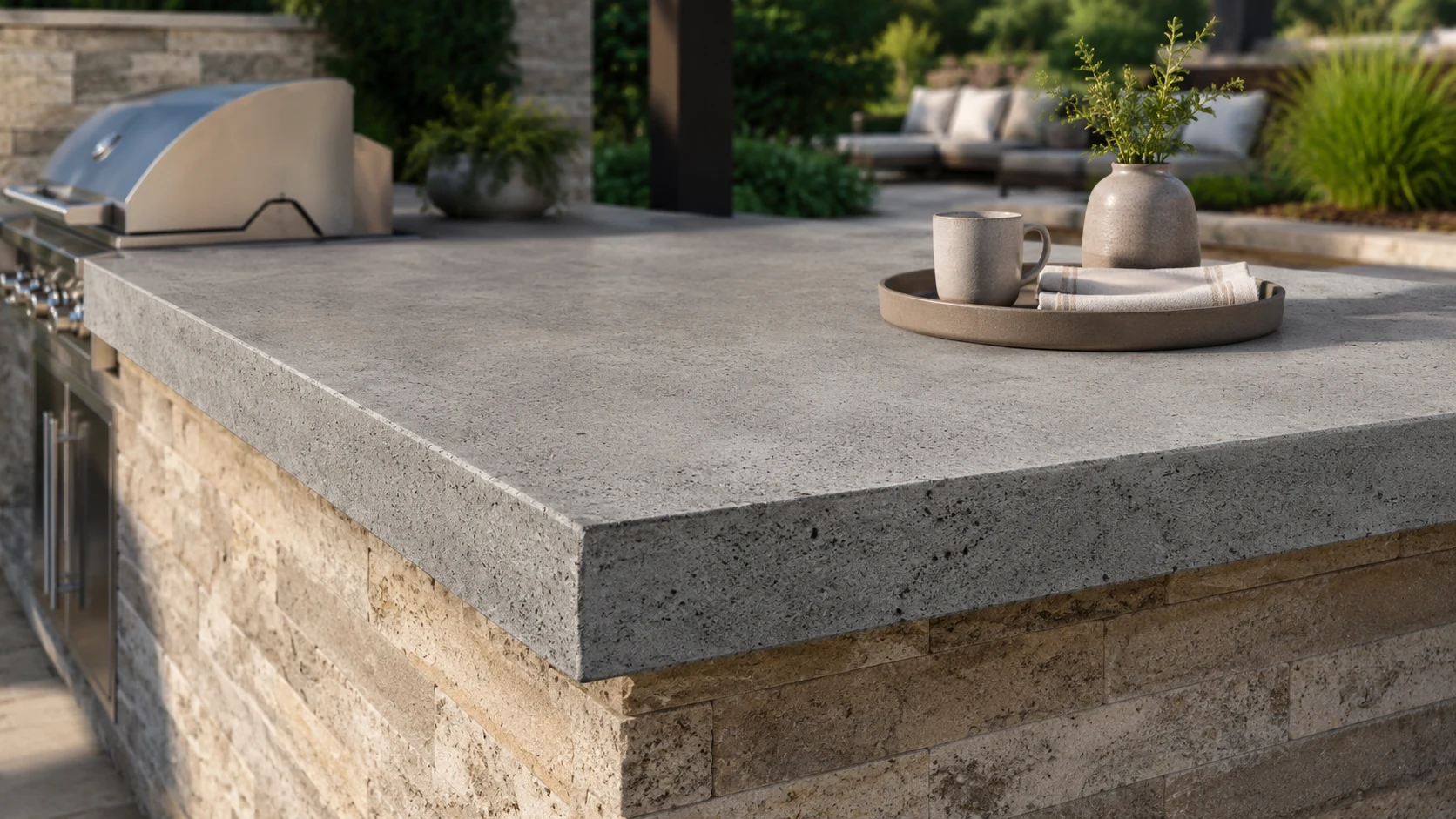
If you are still working out the mix itself, start with the DIY Concrete Countertop Mix Recipe. If the piece is new, read Concrete Cure Time for DIY Outdoor Projects before you even flirt with a sealer label.
Quick Safety Note
Concrete countertop sealers can involve fumes, skin contact risks, flammability concerns, ventilation requirements, cure windows, food-contact claims, surface-prep chemicals, and disposal rules.
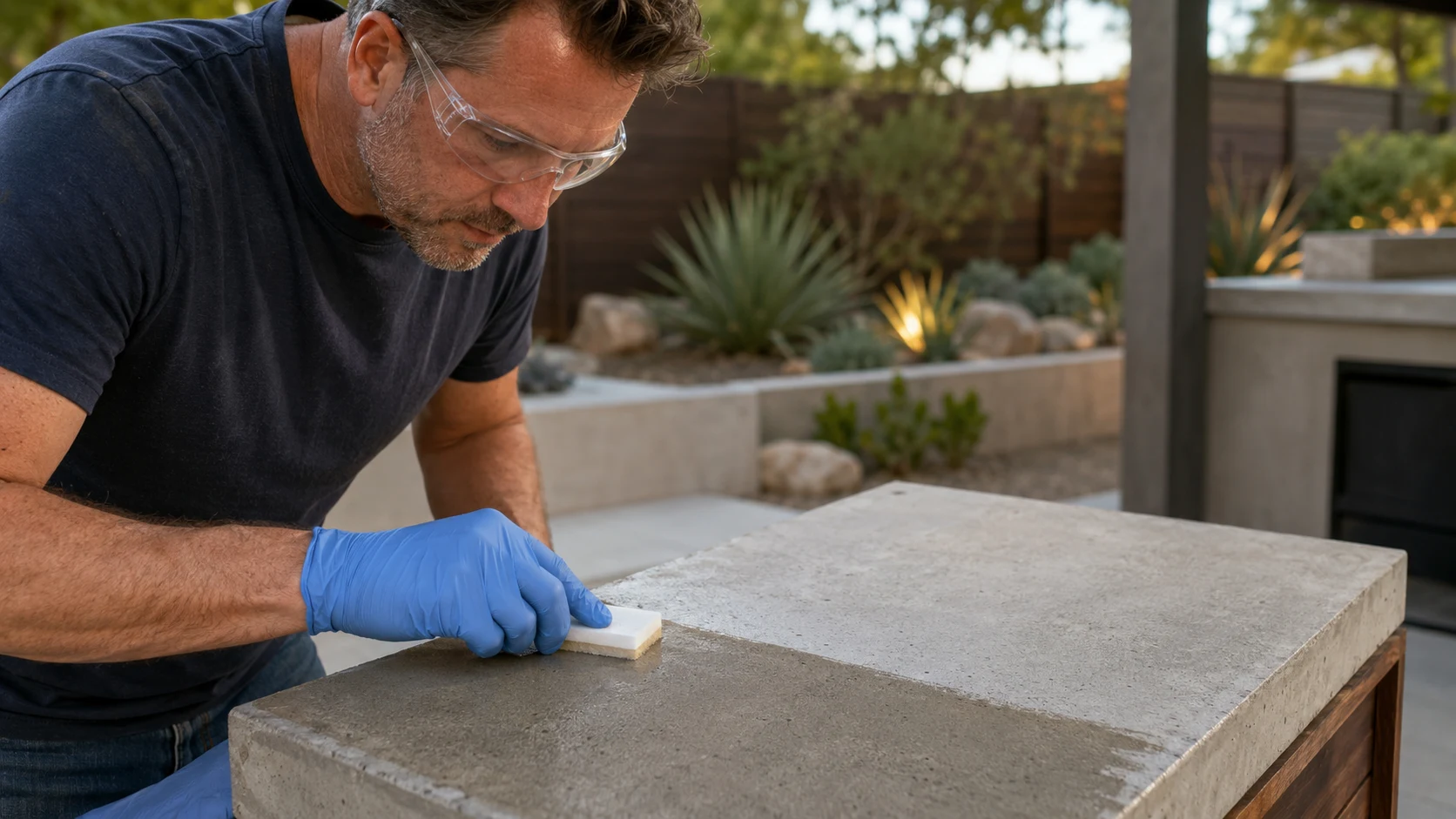
Read the product label and safety data sheet before using any sealer, cleaner, stripper, coating, wax, or maintenance product. Follow the manufacturer's directions for ventilation, gloves, eye protection, respiratory protection, dry time, cure time, recoat windows, cleanup, disposal, and when the surface can be used again.
This guide is product-neutral homeowner education. It is not a product recommendation, food-contact certification, chemical safety manual, commercial kitchen standard, or substitute for the exact product instructions.
The Direct Answer
A DIY concrete countertop usually needs sealing because concrete is porous. Without a compatible sealer or finish system, the surface can absorb water, oil, food spills, grease, wine, soap, cleaning residue, and general household chaos.
The right sealer depends on the exact countertop, finish, use, location, and product instructions. A bathroom vanity top, outdoor grill counter, sheltered potting counter, and indoor kitchen island do not all ask the same thing from a sealer.
Before choosing anything, answer five questions:
- Is the concrete fully cured and dry enough for the product?
- Is the surface clean, dust-free, and compatible with the sealer?
- Will the counter touch food, heat, grease, weather, or frequent cleaning?
- Does the product label support that use?
- Are you willing to maintain the finish later?
If any answer is fuzzy, slow down. Concrete is patient. Sealers are less forgiving.
What Concrete Countertop Sealer Does
Concrete countertop sealer may help:
- Reduce water absorption.
- Slow staining from food, drinks, oils, soap, or outdoor grime.
- Make cleaning easier.
- Reduce surface dusting on some pieces.
- Protect decorative color or finish treatments where compatible.
- Add a matte, satin, wet-look, or glossy appearance.
- Create a more usable surface for kitchens, bars, vanities, potting benches, or outdoor counters.
The keyword is "help." A sealer is not permanent immunity. It does not make the countertop impossible to stain, scratch, scorch, chip, etch, peel, haze, or disappoint.
What Sealer Does Not Do
Sealer does not fix:
- A weak or crumbly mix.
- Poor curing.
- Excess water in the original batch.
- Dusty or poorly finished concrete.
- Active cracking.
- Bad support under the countertop.
- Pinholes, voids, or rough edges you never addressed.
- A surface that is still too young or damp.
- Product incompatibility.
- Unrealistic expectations from the words "countertop" and "concrete" standing too close together.
If the surface looks bad before sealing, the sealer may simply make the problem shinier. That is not restoration. That is lighting design.
For crack prevention and small-project planning, pair this with How to Avoid Cracks in Small DIY Concrete Projects.
Cure Time Comes First
New concrete needs enough curing and drying time before many sealers or coatings can be applied. "It feels hard" is not the same as "it is ready to seal."
Curing is the cement-water reaction that helps concrete gain strength. Drying is the movement of excess moisture out of the concrete. Sealing too early can trap moisture, interfere with bonding, create haze, cause whitening, or contribute to coating failure depending on the product.
The correct timing depends on:
- The concrete mix.
- Slab thickness.
- Water content.
- Additives or pigments.
- Cure method.
- Weather and humidity.
- Indoor vs outdoor exposure.
- The exact sealer instructions.
Use Concrete Cure Time for DIY Outdoor Projects as a planning companion, then let the concrete product and sealer label make the final call.
Main Sealer Categories To Understand
Concrete countertop sealers do not all behave the same way. The names can overlap, and individual products vary, so treat this as a map, not a shopping list.
Penetrating Sealers
Penetrating sealers soak into the concrete instead of building an obvious coating on top.
They may fit when you want:
- A more natural look.
- Less sheen.
- Some reduction in water absorption.
- A surface that still looks like concrete.
Tradeoffs:
- They may not provide the same stain resistance as a stronger topical coating.
- Food, oil, acids, and grease may still be a concern.
- The product must be appropriate for countertop use if that is the intended use.
- Surface porosity and prep matter.
Topical Sealers
Topical sealers form a layer on the surface. Some may be acrylic, polyurethane, epoxy, or other coating systems, but the product chemistry and use rating matter more than the name.
They may fit when you want:
- More stain resistance.
- More visible protection.
- A smoother or more wipeable surface.
- A specific sheen or finish.
Tradeoffs:
- They can peel, scratch, haze, bubble, or wear if prep, moisture, compatibility, or maintenance is wrong.
- They may change the look and feel of the concrete.
- Some are not suitable for food-contact surfaces.
- Some are not suitable for outdoor UV, heat, or weather exposure.
Film-Forming Coatings
Film-forming coatings are a subset of topical products that create a more distinct surface film.
They can be useful, but they raise the stakes. The surface has to be clean and compatible. Moisture has to be handled correctly. Recoat windows matter. Sheen matters. Scratch behavior matters. A film-forming coating can look polished, or it can become the countertop equivalent of peeling nail polish on a job interview.
Wax And Maintenance Coats
Some concrete countertop systems include wax or maintenance coats over another sealer. Wax can add a sacrificial layer and help with everyday cleaning, but it is not the main waterproofing, stain-proofing, or food-contact answer by itself unless the product system says so.
Wax also needs upkeep. If the maintenance plan is "I will never think about this again," wax may have notes.
Indoor Vs Outdoor Countertops
Outdoor concrete counters face a much ruder life than indoor surfaces.
Outdoor exposure can include:
- UV.
- Rain.
- Heat.
- Freeze/thaw cycles where relevant.
- Grease from grills.
- Food spills.
- Dust and pollen.
- Irrigation overspray.
- Wind-blown grit.
- Seasonal temperature swings.
- Cleaning products.
Do not assume a sealer that makes sense for a sheltered indoor vanity is ready for an outdoor kitchen. Also do not assume a patio sealer belongs on a countertop. Patio sealers and countertop sealers may be designed for different surfaces, traction needs, food-contact expectations, cleaning patterns, and appearance standards.
For broader outdoor sealer context, see Concrete Patio Sealer: What Homeowners Should Know.
Stain Resistance Is Not Waterproofing
Stain resistance, water resistance, waterproofing, heat resistance, and food-contact suitability are different claims.
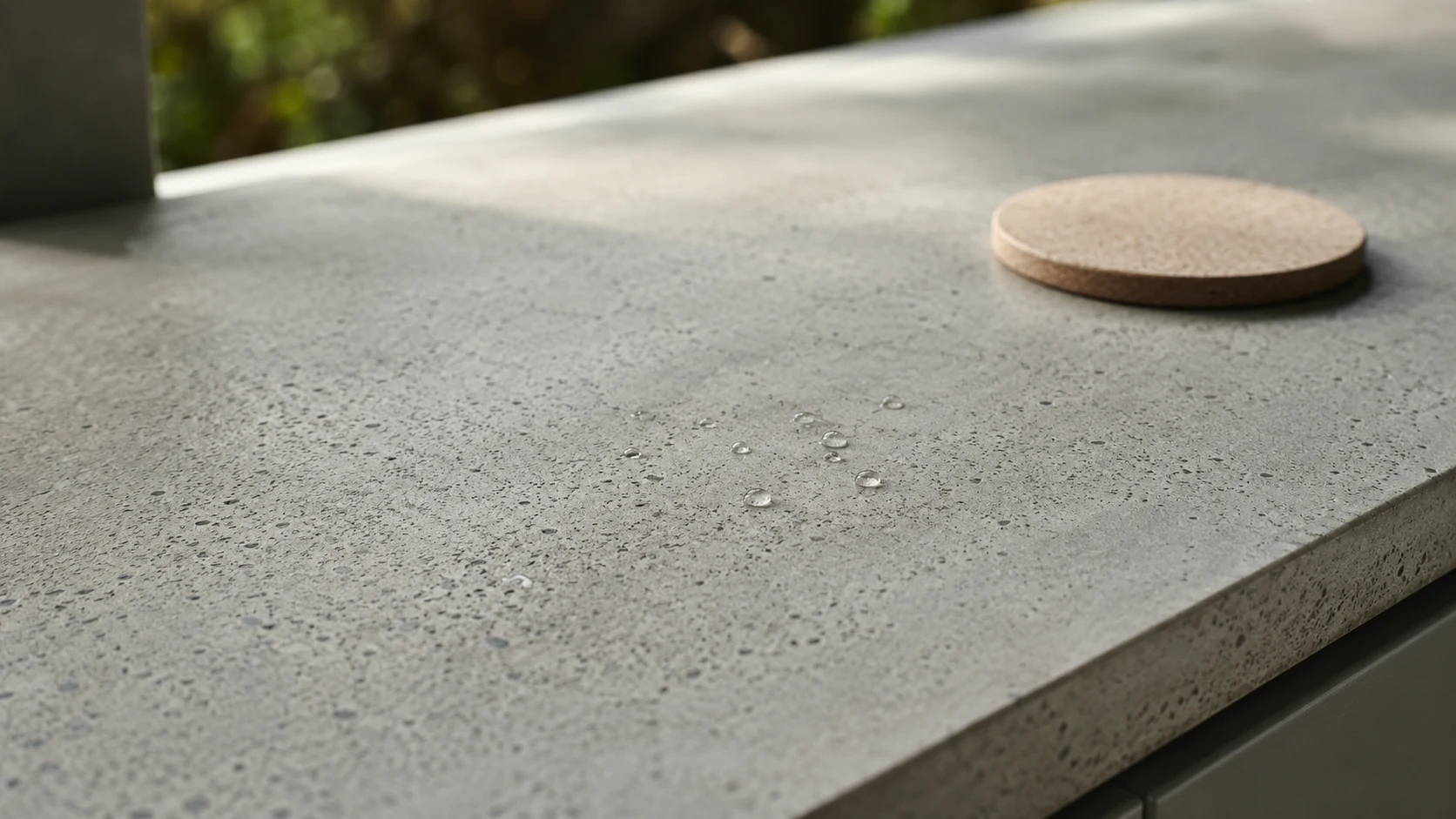
Do not blend them into one magical sentence.
A sealer may resist water better than bare concrete and still stain from oil. It may resist coffee but not acidic food. It may handle occasional wiping but not standing water. It may look beautiful indoors and yellow, chalk, or fail outdoors. It may be safe for incidental contact after cure only if the manufacturer actually supports that use.
The label matters because "concrete sealer" is not one product.
Food-Contact Claims Need Caution
If the counter will be used for food prep, treat food-contact claims carefully.
Do not assume a cured coating is appropriate for direct food contact because it is clear, hard, low-odor, marketed for countertops, or mentioned confidently in a forum. Look for the manufacturer's stated use guidance. If direct food contact matters, confirm what the product actually claims and what conditions apply after full cure.
For high-use kitchens, commercial use, uncertain food-contact needs, or any project where a failure would be a real health or business problem, get professional or manufacturer guidance. A countertop is not improved by guesswork in a nice font.
Heat Resistance Is Not A Hot-Pan Permission Slip
Concrete feels tough, so people treat it like a tiny industrial floor with dinner plates.
Do not put hot pans directly on sealed concrete unless the specific product system says that use is acceptable. Many coatings can discolor, soften, scorch, mark, or lose appearance from heat. Even if the concrete body can tolerate heat better than the coating, the visible surface may not be amused.
Use trivets. This is not weakness. It is choosing not to test chemistry with lasagna.
Finish Compatibility Matters
The surface finish affects how a sealer looks and behaves.
Smooth Or Troweled Finish
Smooth concrete can make a countertop feel refined, but it can also show dust, scratches, roller marks, uneven sheen, or trapped debris more clearly. A glossy coating over a flawed smooth surface may make every small problem audition for attention.
Sanded Finish
Sanded surfaces may open the pores and remove surface residue, but they also create dust that must be cleaned thoroughly before sealing. Sanding dust under sealer is not texture. It is evidence.
Polished Finish
Polished concrete may need a sealer or guard system compatible with the level of polish and porosity. Some sealers will not bond or absorb well if the surface is too dense or too smooth.
Textured Finish
Textured counters can hide some marks, but they can also trap food, grease, and cleaning residue. Sealer may pool or collect unevenly in texture if the product and application are not appropriate.
Outdoor Finish
Outdoor counters need extra attention to UV, weather, cleaning, grease, and freeze/thaw where relevant. A beautiful indoor finish can become a maintenance problem outdoors if the product is not rated for that exposure.
For a broader look at finish choices, Outdoor Concrete Finish Options explains why surface texture affects traction, cleaning, sealing, and maintenance.
Prep Before Sealing
General prep concepts:
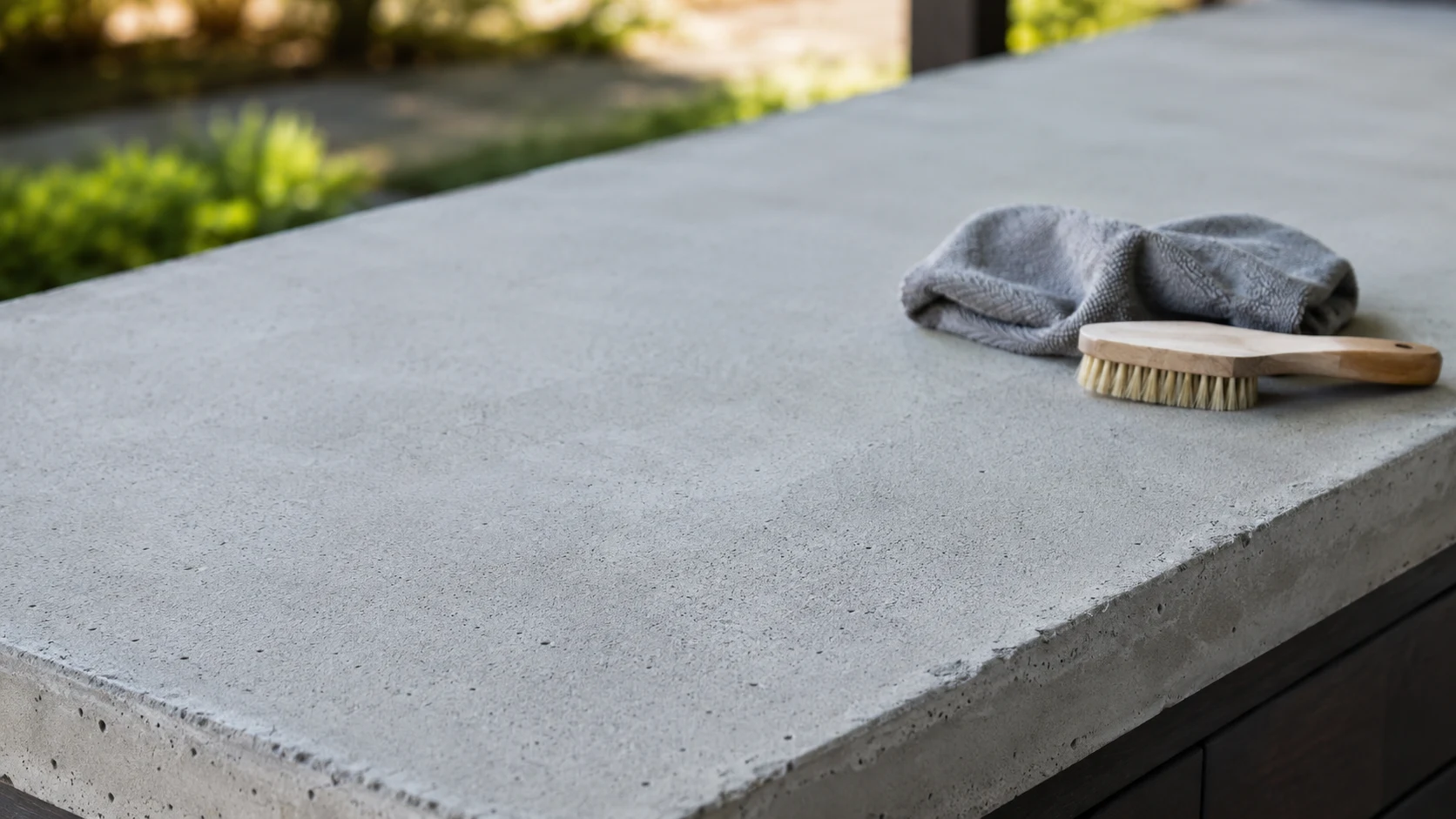
- Let the concrete cure and dry according to the concrete and sealer instructions.
- Remove dust, residue, loose material, and debris.
- Avoid sealing over moisture, oil, grease, wax, curing compounds, or mystery coatings.
- Test in an inconspicuous area when the product directions support it.
- Confirm compatibility with pigments, polishing, previous sealers, waxes, or stains.
- Protect adjacent cabinets, walls, appliances, floors, plants, drains, and hardware.
- Keep kids and pets away from the work area.
- Follow the label for ventilation, PPE, mixing, application, cleanup, dry time, and cure time.
A simple water-drop observation can tell you whether a surface absorbs water quickly or beads for a while, but do not treat it as formal testing. It does not prove product compatibility, cure readiness, food-contact safety, or long-term performance.
Common Mistakes
Avoid these:
- Sealing too early.
- Sealing over dust, residue, moisture, oil, or old failed coating.
- Assuming patio sealer equals countertop sealer.
- Ignoring food-contact claims.
- Choosing sheen from a product photo instead of a test area.
- Expecting sealer to hide bad finishing.
- Using a product not intended for the exposure.
- Skipping maintenance.
- Putting hot pans directly on sealed concrete.
- Using harsh cleaners that the product does not allow.
- Mixing sealers, waxes, cleaners, or strippers outside product directions.
- Treating one online success story as a system.
Most sealer failures are not mysterious. They are the bill arriving for prep, timing, compatibility, or expectations that got skipped earlier.
Maintenance And Resealing
Sealed concrete countertops still need care.
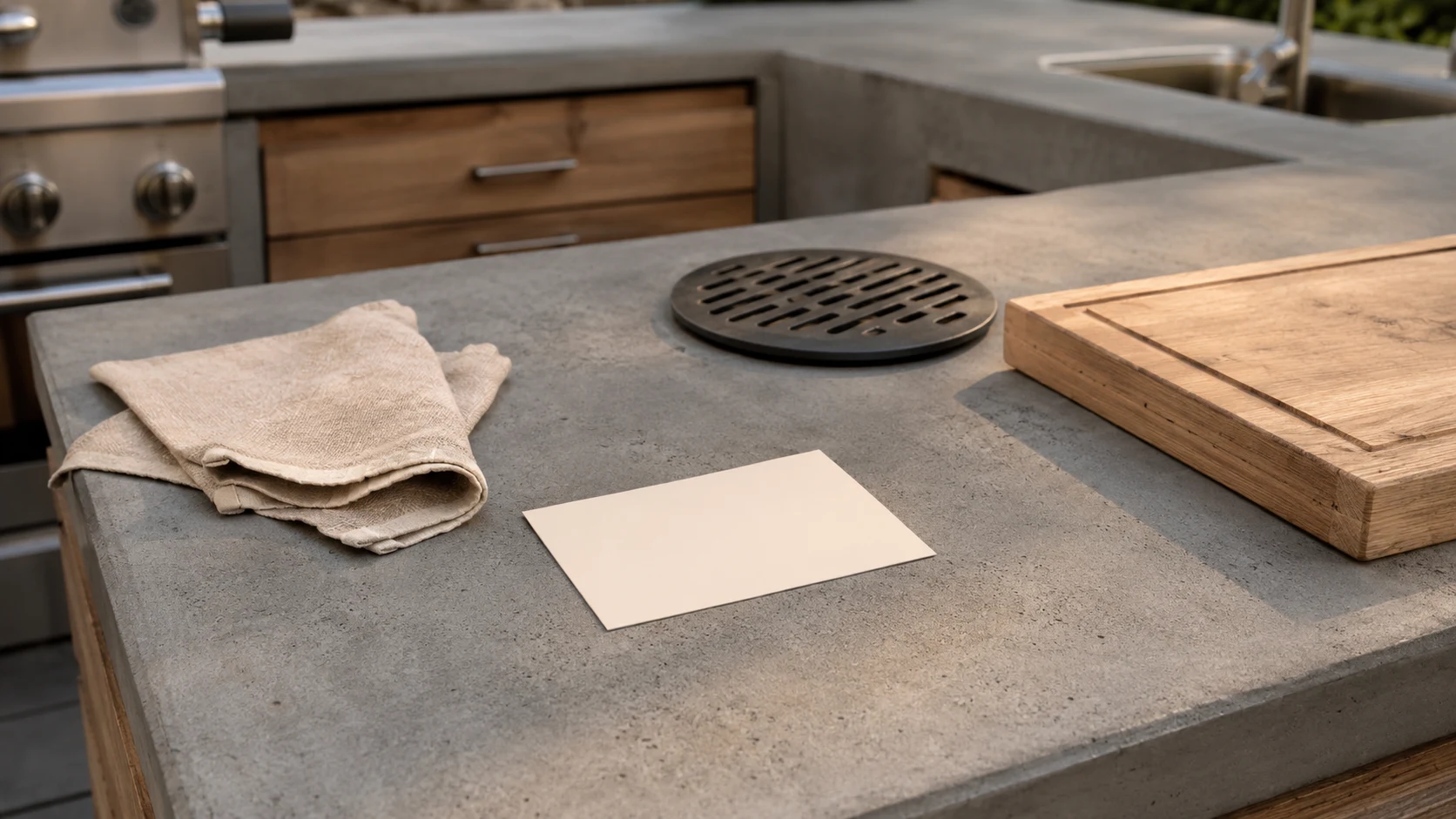
General maintenance may include:
- Wiping spills promptly.
- Using cutting boards instead of cutting directly on the surface.
- Using trivets for hot pans.
- Avoiding harsh cleaners unless the product allows them.
- Avoiding abrasive pads that can dull or scratch the finish.
- Refreshing wax or maintenance coats when the system calls for it.
- Watching for dull spots, staining, water absorption, scratches, haze, or peeling.
- Resealing only according to the product system.
Do not use bleach, acids, degreasers, solvents, abrasive powders, or aggressive pads unless the exact sealer manufacturer says they are acceptable. "It cleaned the grill" is not a countertop-care standard.
When To Call A Professional
Consider professional or manufacturer guidance when:
- The countertop is for a high-use kitchen.
- Direct food contact is important.
- The counter is commercial or rental-facing.
- The piece is large, expensive, or difficult to replace.
- An old sealer is peeling, hazing, whitening, or failing.
- You do not know what product was previously used.
- The surface has oil contamination, curing compound, wax, or mystery residue.
- The counter is outdoors in harsh sun, freeze/thaw, heavy weather, or grill exposure.
- You need a product system with documented food-contact or chemical-resistance claims.
Calling a professional is not admitting defeat. Sometimes it is just refusing to let a $40 decision bully a much more expensive project.
Practical Homeowner Checklist
Before sealing a DIY concrete countertop, confirm:
- The concrete has cured long enough for the chosen product.
- The surface is dry enough for the product.
- The countertop is clean and dust-free.
- The finish is compatible with the sealer.
- The product supports indoor or outdoor use as needed.
- Food-contact expectations are verified from the manufacturer.
- Heat, grease, UV, weather, and cleaning exposure are realistic.
- You understand the required ventilation and PPE.
- You know the dry time, cure time, and return-to-use guidance.
- You have tested appearance in a small area where practical.
- You know the maintenance plan.
If that feels like a lot, good. Sealer is the part of the project where confidence should slow down and read the label.
FAQ
Do concrete countertops need to be sealed?
Usually, yes. Concrete is porous, so a compatible sealer or finish system helps reduce absorption, staining, dusting, and cleaning problems. The right product depends on the countertop use, finish, exposure, and manufacturer instructions.
When should I seal a concrete countertop?
Seal only after the concrete has cured and dried enough for the specific sealer. Do not rely on generic timelines alone. The concrete mix, project thickness, weather, cure method, moisture, and product label all matter.
Is concrete countertop sealer food-safe?
Do not assume that. Food-contact suitability depends on the exact product, full cure, intended use, and manufacturer claims. If direct food contact matters, verify the product documentation or ask the manufacturer before using it.
Can I use patio sealer on a concrete countertop?
Not automatically. Patio sealers and countertop sealers may be designed for different surfaces, exposure, traction needs, food-contact expectations, and cleaning patterns. Use only a product that supports the countertop use you actually need.
Will sealer make concrete waterproof?
Do not count on "waterproof forever." A sealer may reduce absorption or improve water resistance, but performance depends on the product, prep, cure, application, maintenance, and use conditions.
Can sealed concrete handle hot pans?
Do not place hot pans directly on sealed concrete unless the specific sealer system allows it. Many coatings can discolor, mark, soften, or lose appearance from heat. Use trivets and spare yourself the countertop autopsy.
Bottom Line
Concrete countertop sealer is not the glamorous part of the project, but it is the part that decides whether the surface behaves when water, oil, coffee, grease, weather, cleaning, and actual humans show up.
Choose the sealer by use case, not label bravado. Let the concrete cure. Prep the surface. Read the product directions and SDS. Verify food-contact claims instead of assuming them. Test appearance before committing where practical. Maintain the finish after the applause fades.
A concrete countertop can be durable, useful, and handsome. It just needs a sealer plan that respects chemistry more than confidence.