
Firing the pool guy sounds liberating until the water turns cloudy, the test strip looks like a tiny chemistry exam, and the skimmer basket starts judging your life choices.
The good news: a homeowner can take over a lot of routine pool care with a simple rhythm. The less romantic news: pool care is not one heroic Saturday task. It is a repeatable system built around water testing, physical cleaning, equipment checks, chemical safety, and knowing when a professional needs to come back into the story.
This guide is written for the homeowner who wants to understand whether pool service is still necessary, what routine maintenance really involves, and how to build a pool-care habit that does not depend on panic.
The Direct Answer
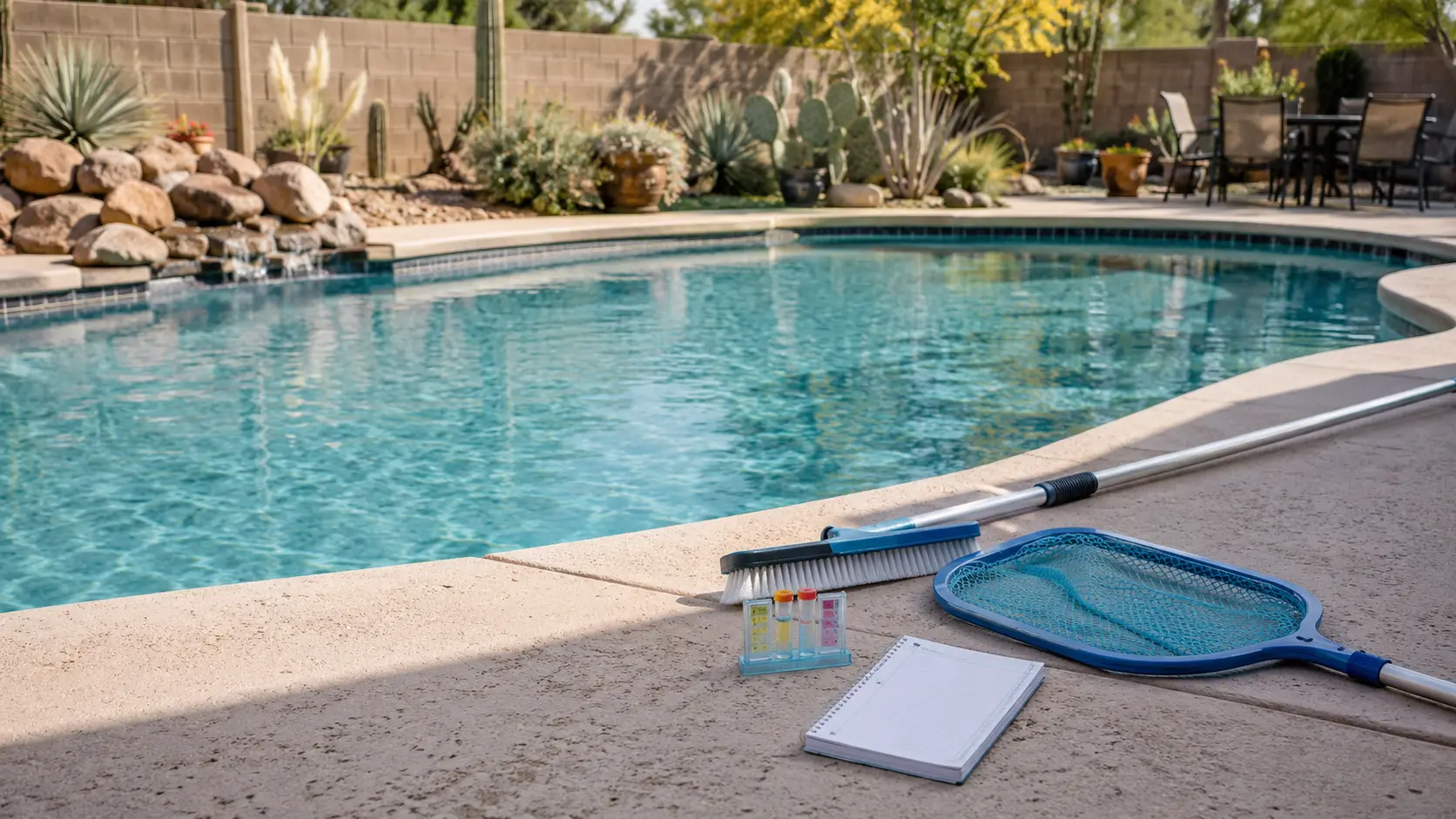
You can often part ways with weekly pool service if you are willing to do four things consistently:
- Test the water and respond to the actual results.
- Remove debris before it becomes a bigger water-quality problem.
- Brush, skim, empty baskets, and clean filters on a schedule.
- Call a professional when the issue touches safety, equipment, leaks, electrical systems, major algae, surface damage, or confusing chemistry.
Robotic cleaners, surface skimmers, and automation can reduce the physical work, but they do not replace testing, chemical safety, filtration, circulation, or judgment. A robot can make the pool cleaner. It cannot make unsafe water safe by vibes.
What Pool Service Is Actually Doing
Before replacing a pool service, it helps to understand the job.
A typical pool visit may include:
- Testing sanitizer and pH.
- Adjusting chemicals.
- Skimming the surface.
- Brushing walls, steps, benches, and tile lines.
- Vacuuming or running cleaning equipment.
- Emptying skimmer and pump baskets.
- Checking water level.
- Inspecting visible equipment issues.
- Cleaning or backwashing filters when needed.
- Watching for algae, cloudy water, stains, leaks, air in the system, or pump problems.
Some companies do more. Some do less. The point is not to copy the service visit exactly. The point is to turn the work into a homeowner routine that keeps the water safe, clear, and less likely to surprise you.
The Pool-Care Job Has Two Halves
Most homeowners think pool care is about chemicals.
Chemistry matters, but it is only half the job.
The first half is water care:
- Sanitizer.
- pH.
- Stabilizer where relevant.
- Alkalinity, calcium hardness, salt, or other readings depending on the pool.
- Safe chemical handling.
- Product labels and safety data sheets.
The second half is physical care:
- Skimming.
- Brushing.
- Removing leaves, flowers, bugs, dust, and storm debris.
- Emptying baskets.
- Cleaning filters.
- Keeping the pump and circulation system doing useful work.
- Noticing changes before they become emergencies.
The pool usually gets easier when both halves work together. If the water is balanced but debris is sinking all week, you are behind. If the pool looks clean but the sanitizer and pH are off, you are also behind. Clear water is not a legal contract.
Start With A Baseline Week
Do not cancel service and freestyle the next morning.
Start with a baseline week while the pool is still in normal condition:
- Photograph the equipment pad, valves, pump basket, filter, cleaner setup, waterline, steps, and any recurring problem areas.
- Write down the pool type, surface, sanitizer type, filter type, cleaner type, pump schedule, and usual service day.
- Test the water yourself and compare your result with the service result if possible.
- Watch how fast debris collects between cleanups.
- Note which chores you already know how to do and which ones make you nervous.
This is not busywork. It gives you a starting map. A homeowner without a baseline is not doing pool care; they are entering a mystery with a net.
Build The Weekly Rhythm
A practical homeowner routine can be simple:
- Test water at least on a consistent schedule, and more often during heavy use, hot weather, storms, or after unusual events.
- Skim floating debris before it sinks.
- Brush walls, steps, benches, Baja shelves, corners, and waterline areas.
- Empty skimmer baskets, pump baskets, robotic cleaner baskets, and surface skimmer baskets.
- Check water level.
- Look at the pump, filter pressure or indicator, cleaner movement, returns, suction, and obvious leaks.
- Clean or backwash the filter according to the filter type and manufacturer guidance.
- Record what changed.
The exact cadence depends on the pool, climate, swimmer load, nearby planting, equipment, filter type, and season. A sunny Scottsdale pool under bougainvillea, oleander, wind, and desert dust does not behave like a shaded pool in a mild climate. Your routine should respond to the pool you actually own.
What To Test
At minimum, a homeowner should understand sanitizer and pH.
CDC guidance frames chlorine or bromine and pH as the first defense against germs in pool water. It also recommends routinely checking chlorine concentration and pH and following product/manufacturer directions for the testing method.
That does not mean this article should become a dosing chart. It should not. Pool chemistry depends on pool volume, sanitizer type, cyanuric acid, water temperature, sunlight, bather load, product strength, equipment, source water, and local conditions.
Use this guide to understand the job. Use the product label, test-kit instructions, and qualified pool guidance to make chemical decisions.
The Less-Scary Way To Think About Pool Chemistry
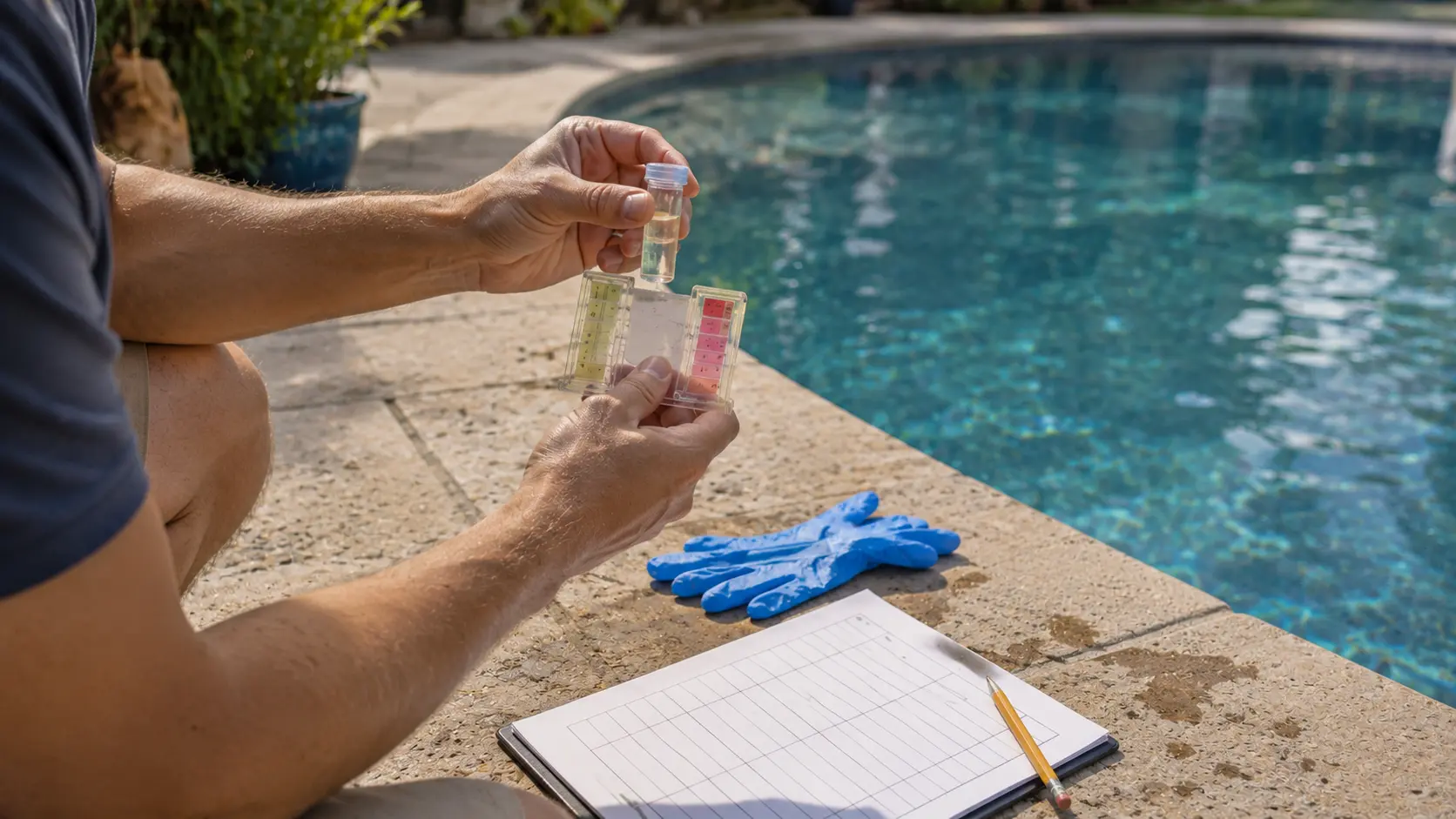
The chemical side of pool care feels intimidating because it sounds like a science project with consequences. A better way to think about it is as a calm sequence:
- Test the water.
- Write down the result.
- Compare the result with your test-kit, product-label, and qualified pool guidance.
- Make one deliberate adjustment at a time when an adjustment is needed.
- Let the pool circulate.
- Re-test or re-check according to the product and test-kit directions.
That rhythm matters more than confidence theater. The homeowner job is not to memorize every chemical interaction. The homeowner job is to know what system the pool uses, test consistently, follow labels, avoid mixing chemicals, keep a log, and stop when something does not make sense.
If you remember only one thing, remember this: do not guess with pool chemicals. Test first. Read first. Add only according to the directions for the specific product, pool, and test result in front of you.
Regular Chlorine Pools Versus Saltwater Pools
Saltwater pools confuse a lot of homeowners because the name sounds like an alternative to chlorine. In normal homeowner terms, it is better to think of a saltwater pool as a chlorine pool with a generator.
A traditional chlorinated pool usually relies on added chlorine products. A saltwater pool uses dissolved salt and a salt chlorine generator to create chlorine for the water. Both systems still need sanitizer awareness, pH testing, safe chemical handling, circulation, filtration, brushing, skimming, and professional help when the water or equipment is outside your knowledge.
| System | What it usually means for the homeowner | Watch-outs | | --- | --- | --- | | Regular chlorinated pool | You add or manage chlorine products directly according to labels and test results. The setup can be straightforward and familiar. | You still need to store and handle chemicals safely, avoid mixing products, and prevent the pool from drifting because you skipped testing. | | Saltwater pool | A salt chlorine generator makes chlorine from salt in the water. The water may feel gentler to some swimmers and routine chlorine handling may feel less hands-on. | It is not chemical-free. You still test and manage water balance, inspect equipment, and maintain the generator cell according to manufacturer guidance. |
Pros And Cons Of A Regular Chlorinated Pool
Potential advantages:
- Familiar equipment and service support.
- No salt chlorine generator cell to maintain or replace.
- Clear connection between test result, product label, and chemical action.
- Often easier to understand for a homeowner taking over an existing pool.
Potential drawbacks:
- More direct handling and storage of chlorine products.
- More temptation to treat pool care as product-by-product guessing.
- Poor storage, wet containers, unlabeled containers, or mixed products can create real safety risks.
Pros And Cons Of A Saltwater Pool
Potential advantages:
- Chlorine generation is more automated when the system is working correctly.
- Some owners prefer the water feel.
- Routine maintenance may feel less like adding sanitizer by hand.
Potential drawbacks:
- Saltwater is not a no-chemicals system.
- The generator cell, controller, flow, salt level, pH, and water balance still need attention.
- Conversion adds equipment decisions, installation quality, compatibility questions, and future replacement parts.
- A saltwater pool can still become cloudy, unsafe, scaled, algae-prone, or out of balance.
Should You Convert To Saltwater?
Do not convert because someone told you saltwater is maintenance-free. It is not.
Consider a conversion only after you understand:
- Your current pool surface, equipment, plumbing, controls, and warranty posture.
- Whether the existing equipment can support the change.
- What the salt chlorine generator requires for installation, operation, cleaning, inspection, and replacement.
- How the system changes your testing routine.
- Whether a qualified pool professional should evaluate compatibility before installation.
For many homeowners, the first decision is not "chlorine or saltwater." It is "Can I test, log, clean, and respond consistently?" A salt system can reduce some friction, but it does not replace the pool owner.
Chemical Safety Comes Before Confidence
Pool chemicals are useful because they are reactive. That is also why they can hurt people when handled badly.
Practical safety rules:
- Read and follow the product label every time.
- Keep safety data sheets available for products you store.
- Wear the protective gear the product calls for.
- Store chemicals in original labeled containers.
- Keep chemicals dry unless the label says otherwise.
- Keep incompatible chemicals separated.
- Do not mix chemicals together.
- Do not add water to chemicals unless the product instructions say to do that.
- Keep chemicals away from children, pets, food, drinks, gasoline, open flames, and casual curiosity.
- Dispose of old, damaged, unlabeled, or unwanted chemicals through the proper local path.
If that sounds more serious than the average pool-store aisle, good. Chemical safety should feel a little boring and a little strict. Boring and strict is a fine personality for things that can release toxic vapor when mishandled.
Skimming Is Not Optional
Surface debris looks harmless until it sinks, stains, clogs baskets, feeds water-quality problems, or turns a quick cleanup into archaeology.
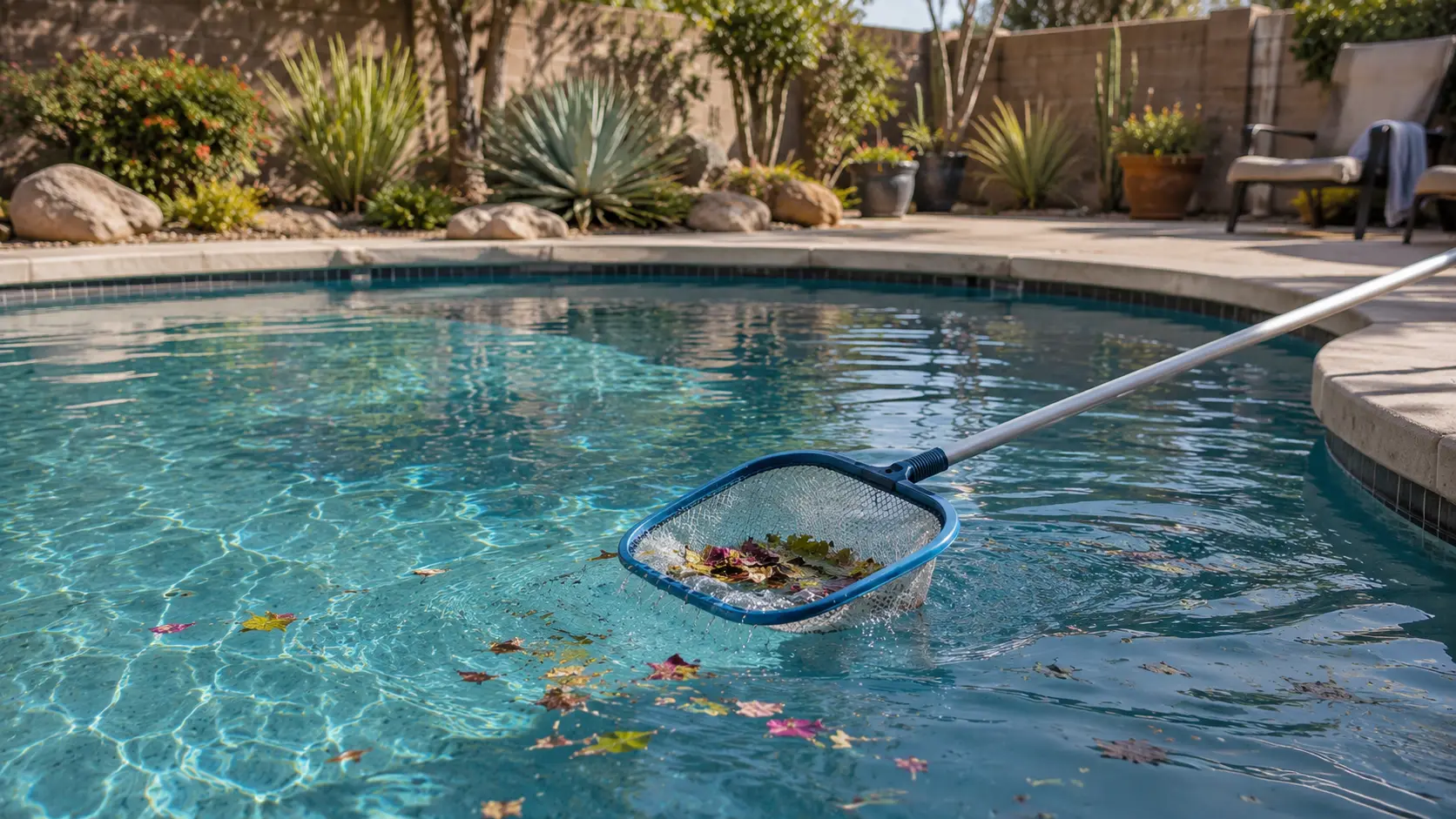
A pool near flowering plants can be especially needy. Landscapade's owner notes from a Scottsdale pebble-finish pool mention bougainvillea bracts, oleander flowers, bugs, pollen, wind debris, dust, and storm debris as recurring issues. That is not every pool, but it is a useful reminder: the landscape around the pool is part of the maintenance system.
Skim often enough that debris does not become a second layer of pool surface. After wind or storms, expect more.
Robotic surface skimmers can reduce this chore, but they still need basket cleaning, monitoring, and manual backup. They are helpers, not resignation letters from pool ownership.
Brushing Still Matters
Brushing is easy to skip because it feels old-fashioned.
It still matters.
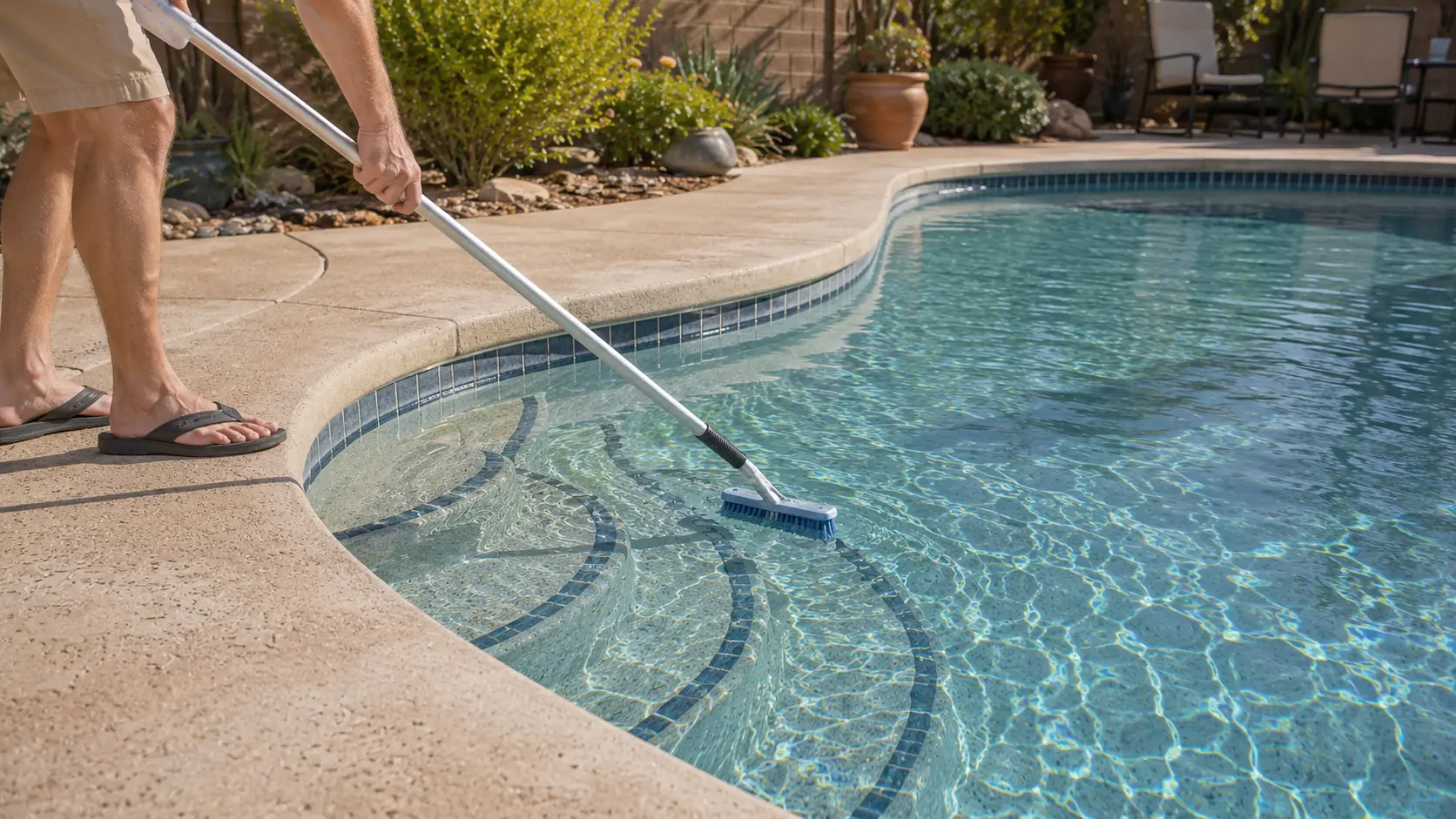
Brush:
- Steps.
- Benches.
- Baja shelves.
- Corners.
- Waterline areas.
- Walls.
- Behind ladders or rails where applicable.
- Dead spots where circulation is weak.
Brushing helps move material into the water where filtration and sanitation can do their jobs. It also forces you to look closely at the surface. That matters because algae, scale, staining, rough patches, and debris buildup usually start small enough to ignore.
If brushing suddenly feels harder, if the surface looks different, or if a stain appears after a storm or metal debris event, do not guess your way into a chemical experiment. Stop and identify the problem.
Baskets Are The Chore That Tells On You
Skimmer baskets, pump baskets, robotic cleaner baskets, and robotic skimmer baskets are not glamorous. They are also where a lot of pool neglect confesses.
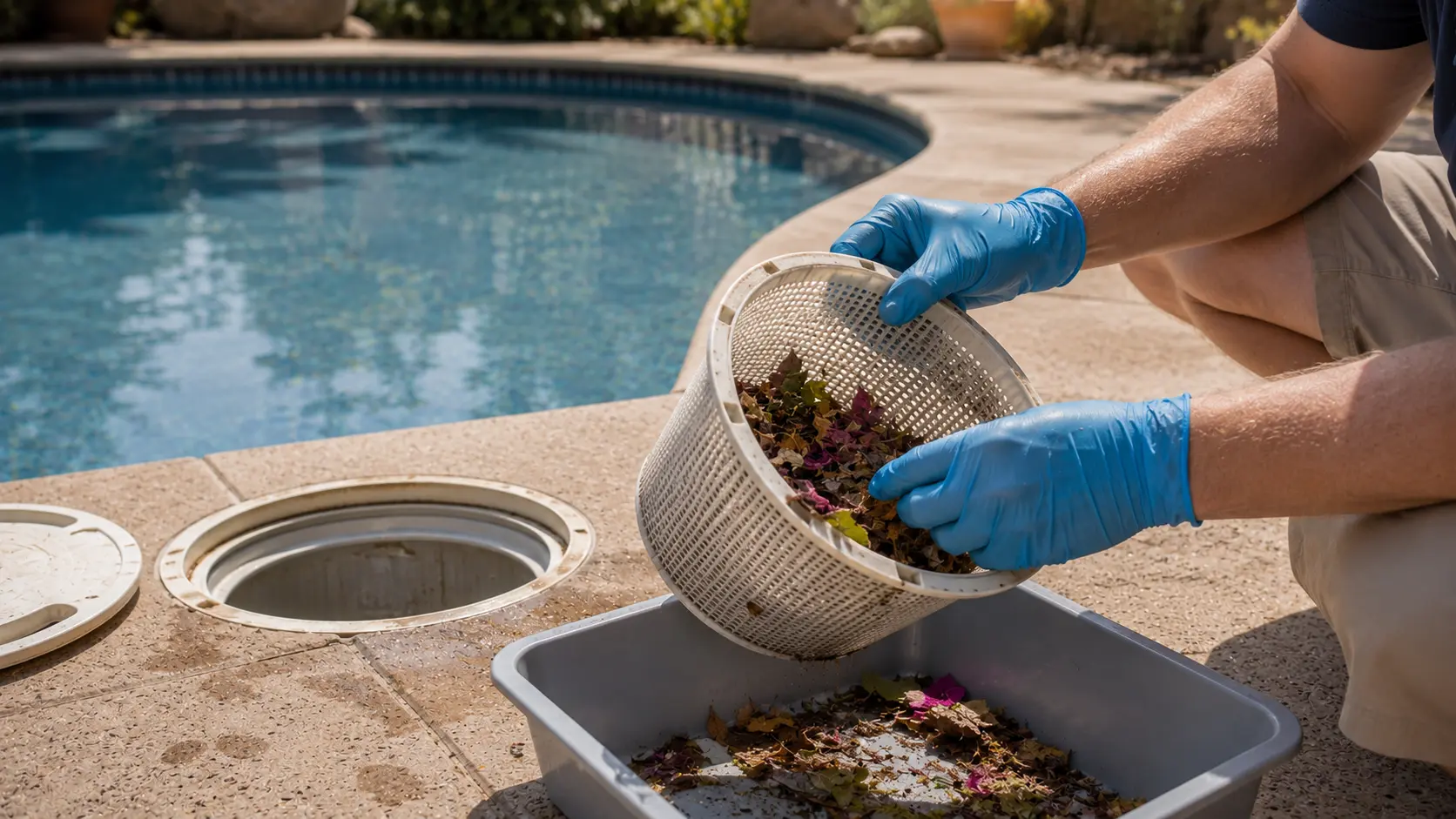
Check baskets often enough that water flow and cleaner performance do not suffer. After wind, storms, shedding plants, or heavy use, check sooner.
For a pool with bougainvillea, oleander, wind debris, and desert dust, Steve's owner notes point to a simple reality: baskets fill because the yard keeps contributing material. The cleaner the basket, the better chance the equipment has to do its job.
Turn equipment off before opening pump baskets, follow the equipment manual, and do not force lids, valves, clamps, or anything under pressure. If you are not sure how to open, close, prime, or restart equipment safely, that is a professional-help moment.
Filters Decide Whether Cleaning Sticks
A pool can look better after skimming and brushing, but the filter is what helps keep fine material from staying in the water.
Know what type of filter you have:
- Cartridge.
- DE.
- Sand.
Each has different cleaning, pressure, backwash, grid, cartridge, disposal, and maintenance expectations. Follow the manufacturer guidance for your filter. Do not treat one internet routine as universal.
Watch for:
- Cloudy water that does not clear.
- Weak return flow.
- Pressure readings that change from the clean baseline.
- Air bubbles.
- Pump basket problems.
- Cleaner performance changing suddenly.
- Water bypassing or returning dirty.
Those signs do not all mean the same thing. They mean the filter and circulation system deserve attention before the pool becomes an outdoor soup project.
Robotic Cleaners Can Change The Routine
Robotic cleaners can make pool ownership feel dramatically easier, especially when the problem is physical debris rather than chemistry.
Steve's published owner notes describe a Scottsdale pool where a robotic floor cleaner handles routine floor, wall, waterline, fine-dust, leaf, and bougainvillea-bract cleanup, while a robotic surface skimmer reduces daily net work from flowers, bugs, pollen, and floating debris.
That is valuable context, not a universal prescription.
Robots can help with:
- Routine floor cleaning.
- Walls or waterline passes, depending on the model and pool.
- Fine sediment, depending on filter setup.
- Surface debris, if using a surface skimmer.
- Keeping the pool visually cleaner between manual interventions.
Robots do not replace:
- Water testing.
- Chemical safety.
- Filter maintenance.
- Brushing every surface in every pool.
- Baskets and cleaner maintenance.
- Manual storm cleanup.
- Equipment repair.
- Professional help when the pool is outside your knowledge.
Use automation to reduce friction. Do not use it to stop paying attention.
The Daily, Weekly, Monthly, And Seasonal Pattern
Think in layers.
Daily or near-daily awareness:
- Look at the water.
- Notice surface debris.
- Listen for strange equipment sounds.
- Check that automated cleaners are not stuck.
- Look for obvious changes after wind, storms, parties, or heavy swimming.
Weekly routine:
- Test water.
- Empty baskets.
- Skim as needed.
- Brush surfaces.
- Check water level.
- Review cleaner baskets and filter pressure/indicator.
- Confirm the pump schedule still makes sense for the season.
Monthly or periodic routine:
- Clean filters according to type and manufacturer guidance.
- Inspect equipment for leaks, cracks, worn parts, odd sounds, or air.
- Review recurring trouble spots.
- Clean robotic cleaner filters or baskets more deeply.
- Check storage and condition of pool chemicals.
- Revisit whether the routine is still working.
Seasonal routine:
- Adjust expectations for heat, sunlight, monsoon storms, pollen, leaves, bather load, and shorter winter days.
- Review safety equipment.
- Check whether plants near the pool are creating predictable debris waves.
- Revisit professional service if the pool is repeatedly drifting out of control.
This is the system that lets a homeowner part ways with weekly service without parting ways with responsibility.
When To Call A Pool Professional
Call for help when:
- You cannot keep sanitizer and pH in range.
- The water is cloudy, green, or unsafe-looking.
- Algae keeps returning.
- You suspect a leak.
- The pump loses prime.
- Equipment is making new noises.
- Filter pressure or flow changes in a way you do not understand.
- Electrical equipment, bonding, timers, automation, or wiring are involved.
- You need to open pressurized equipment and do not know the safe procedure.
- Stains, scale, rust, or surface damage need diagnosis.
- Chemical labels are unclear or conflict with advice you received.
- Someone had diarrhea in the pool or there is a contamination event.
- You are preparing for travel and cannot maintain the routine.
The goal is not to never call a pro. The goal is to stop paying for mystery. Use professionals for the work that actually needs professional knowledge, not as a weekly subscription to avoid learning what the skimmer basket does.
The First 30 Days After Canceling Pool Service
If you decide to take over, treat the first month like training.
Week 1:
- Record your baseline.
- Test water yourself.
- Learn each basket and filter access point.
- Watch how debris moves through the pool.
- Keep service active if possible while you learn.
Week 2:
- Take over skimming, brushing, and baskets.
- Start a written log.
- Compare your water test results with a trusted reference if available.
- Identify the chores you are avoiding.
Week 3:
- Clean or inspect the filter according to its type and manual.
- Review cleaner performance.
- Notice which parts of the pool collect debris or algae first.
- Tighten the routine around those weak spots.
Week 4:
- Decide whether the routine is realistic.
- Keep the parts you can handle.
- Hire help for the parts you cannot safely or consistently handle.
- Do not treat partial help as failure.
Sometimes the best answer is not full DIY or full service. It is a better mix: homeowner routine care plus professional equipment, filter, or chemistry help when needed.
A Practical Homeowner Checklist
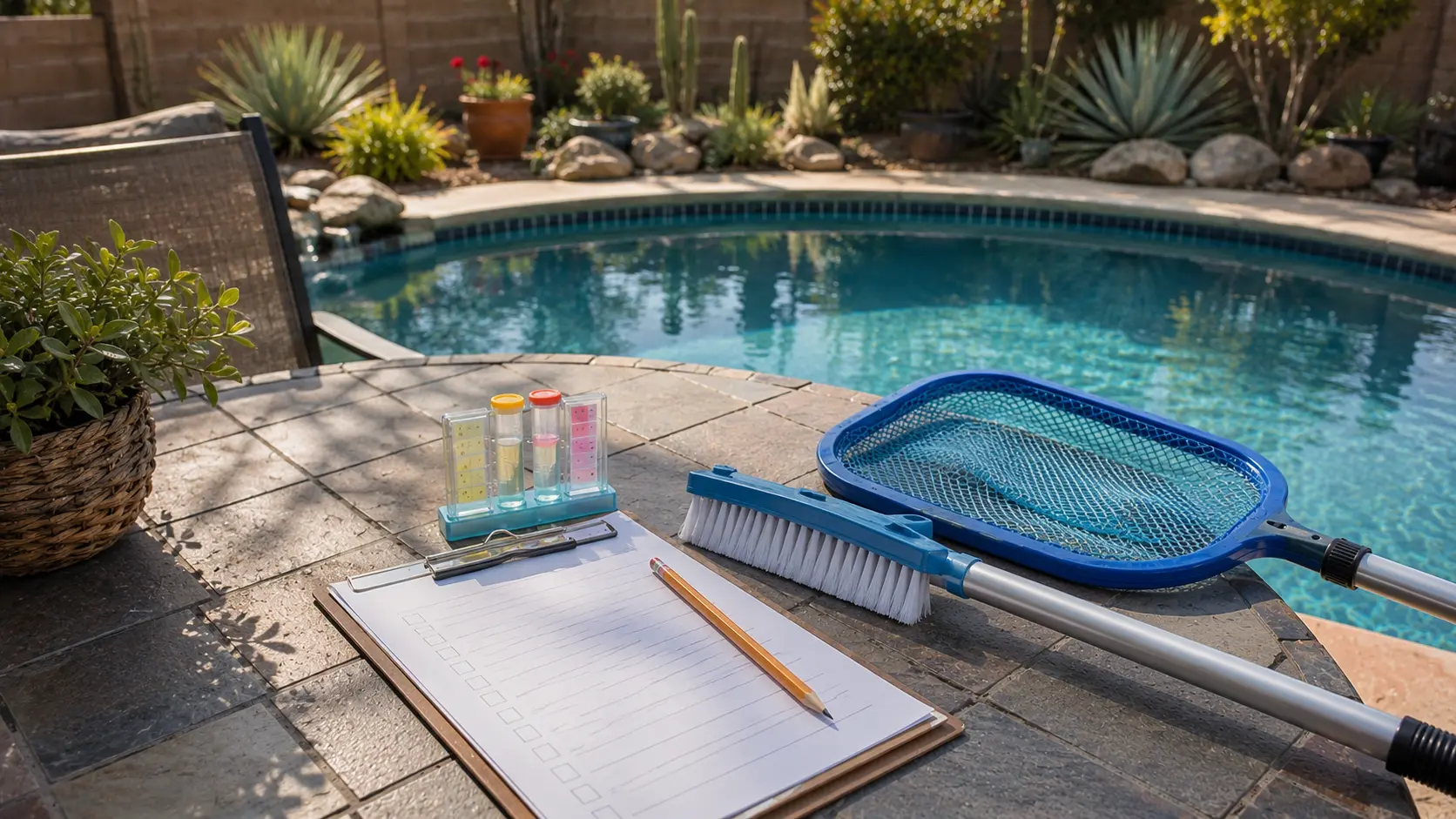
Before you part ways with pool service, make sure you can answer yes to these:
- I know what sanitizer system my pool uses.
- I know how to test sanitizer and pH.
- I know where the skimmer baskets are.
- I know how to safely empty the pump basket.
- I know what filter type I have.
- I know the normal filter pressure or clean baseline where applicable.
- I know how my cleaner works and what maintenance it needs.
- I know where the pool chemicals are stored.
- I have read the labels for the chemicals I use.
- I have the protective gear those labels require.
- I know when to stop and call a professional.
- I am willing to keep a simple log.
If several answers are no, do not cancel service yet. Use the next visit to ask questions, watch the routine, and build your handoff plan.
Download The Handoff Checklists
Use the checklist that matches the pool you actually have:
Both checklists are reminders, not dosing instructions. Product labels, safety data sheets, test-kit directions, equipment manuals, and qualified pool guidance still control the chemical decisions.
FAQ
Can I really maintain my own pool?
Often, yes, if the pool is in good condition and you are willing to test water, remove debris, brush surfaces, empty baskets, maintain filters, and call for help when the problem moves beyond routine care. Some pools and owners will still be better served by partial or full professional service.
How often should I test pool water?
Use a consistent schedule and test more often during heavy use, hot weather, storms, or water-quality changes. CDC homeowner guidance emphasizes regular chlorine and pH checks and says to follow the testing manufacturer's directions.
Do robotic pool cleaners replace pool service?
No. Robotic cleaners can reduce physical cleaning, but they do not replace water testing, chemical handling, filter maintenance, equipment inspection, or professional diagnosis. They are tools inside a pool-care system, not the whole system.
What is the hardest part of taking over pool care?
The hardest part is consistency. Most routine pool care is not mysterious. It is just easy to skip until the water, baskets, filter, or equipment make the consequences visible.
Should I keep a pool log?
Yes. A simple log helps you notice patterns: test results, chemical additions, storms, debris waves, filter cleaning, basket cleaning, algae, cloudy water, and equipment issues. The log turns pool care from guessing into memory.
When should I not DIY pool care?
Do not DIY when the issue involves electrical work, unsafe water, unclear chemical reactions, major algae, suspected leaks, equipment repair, pressure vessel confusion, surface damage, or anything you do not understand well enough to handle safely.
Final Take
You do not need to become a pool professional to stop feeling trapped by pool service.
You do need a routine.
Test the water. Remove debris. Brush the surfaces. Empty the baskets. Maintain the filter. Respect the chemicals. Use automation where it actually helps. Call a professional when the pool is no longer asking a routine homeowner question.
That is how pool care becomes manageable: not effortless, not magical, but repeatable enough that the pool stops feeling like it belongs to someone else.