
Pool testing feels intimidating because the pool looks peaceful while the test strip looks like it is judging your education. The good news is that you do not need to become a chemist to build a calmer testing routine. You need a repeatable sequence, a written log, a healthy respect for labels, and a clear point where guessing stops.
This guide is for homeowners who want to understand the rhythm of testing a residential pool without turning it into a chemical recipe. It is product-neutral. Test-kit instructions, pool chemical labels, safety data sheets, equipment manuals, local requirements, and qualified pool professionals still control what you should do for your exact pool.
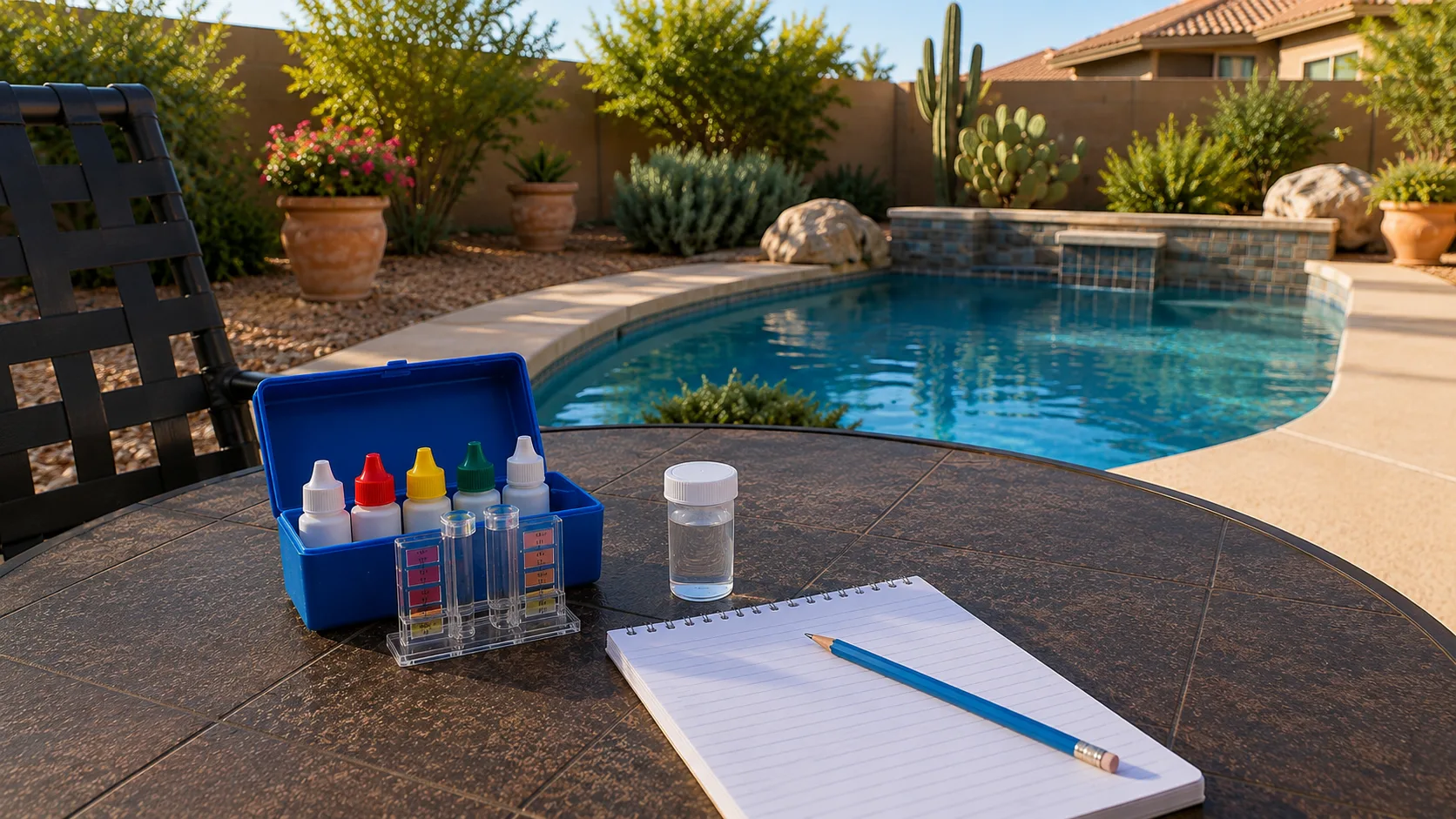
The Direct Answer
A simple homeowner pool testing routine looks like this:
- Test sanitizer and pH on a consistent schedule.
- Test more often after heavy swimming, hot weather, storms, dust, debris, or unusual water behavior.
- Write down the result before adjusting anything.
- Compare the result with the test-kit instructions, product labels, and qualified pool guidance for your pool type.
- Make only one deliberate adjustment at a time when an adjustment is needed.
- Let the water circulate.
- Retest according to the test-kit and product directions.
- Call a pool professional when the result, product label, equipment behavior, or water condition does not make sense.
If you are taking over service for the first time, start with Pool Care Without the Pool Guy. If the testing question came up after wind, dust, or debris, Pool Care After a Dust Storm is the cleanup companion.
What You Are Actually Testing
For most homeowners, the first two readings to understand are sanitizer and pH.
Sanitizer is the part of pool care that helps control germs. In many residential pools, that means chlorine. In some systems, it may mean bromine or another setup, especially in hot tubs or specialty systems. This article stays with residential pool basics and does not try to cover every sanitizer system.
pH tells you how acidic or basic the water is. It matters because pH affects swimmer comfort, equipment and surface conditions, and how well chlorine can do its job.
CDC frames chlorine and pH as first defenses against swimming-related illness in pool water. CDC also recommends regular homeowner testing of chlorine concentration and pH, and says owners should follow the manufacturer's directions for whatever test method they use.
That last sentence is the one to tape to the equipment pad: follow the directions for the test in your hand.
The Calm Testing Sequence
Use the same sequence every time.
1. Start With Clean Hands And A Clean Sample
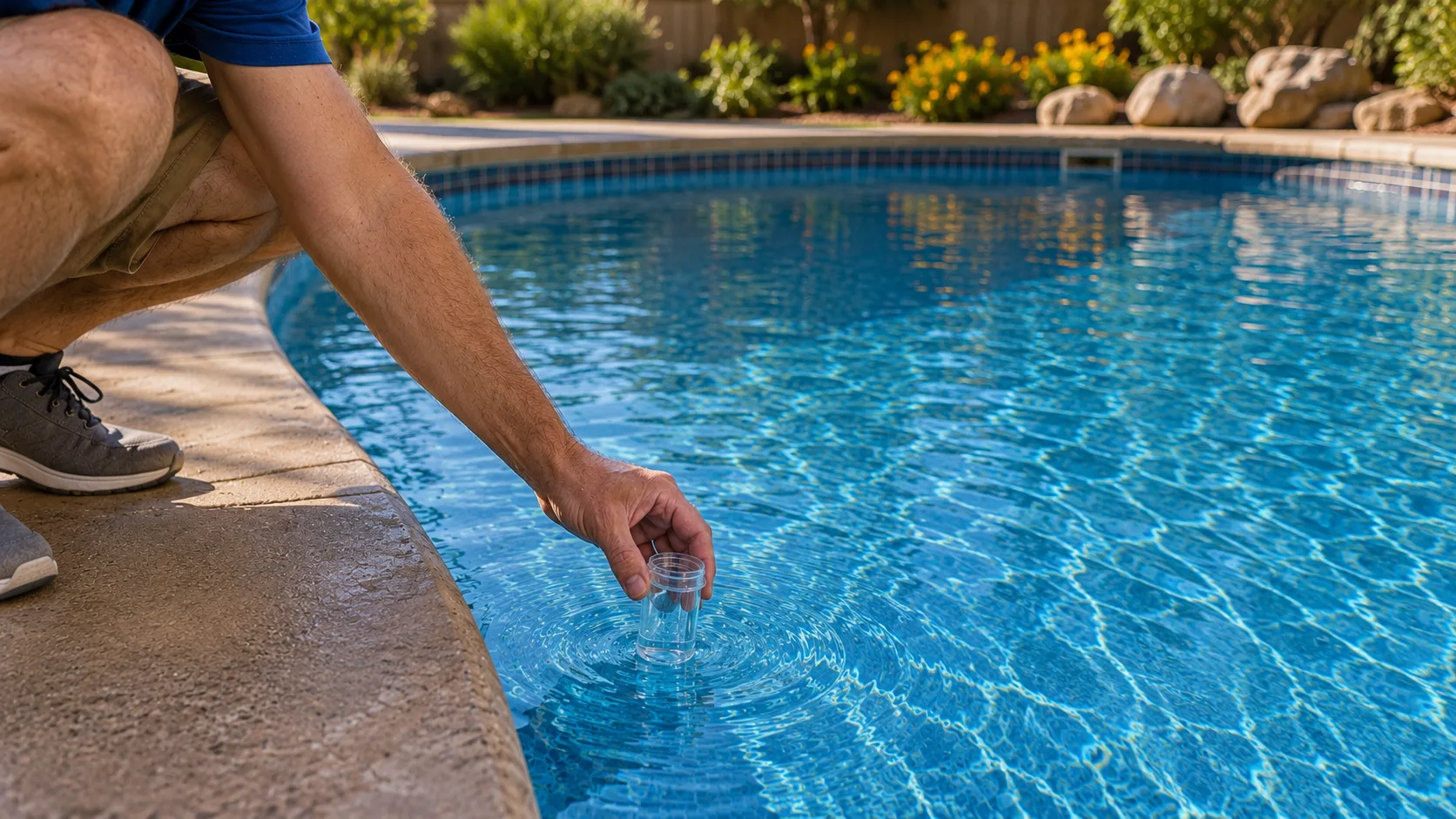
Do not test from a dirty cup, a puddle on the deck, or water right beside a return jet. Follow your test-kit directions for where and how deep to collect the water sample.
If the directions say to rinse the sample container with pool water first, do that. If the directions say to read the result within a specific time window, do that too. Tiny shortcuts create confusing results.
2. Read The Result Before You Decide What It Means
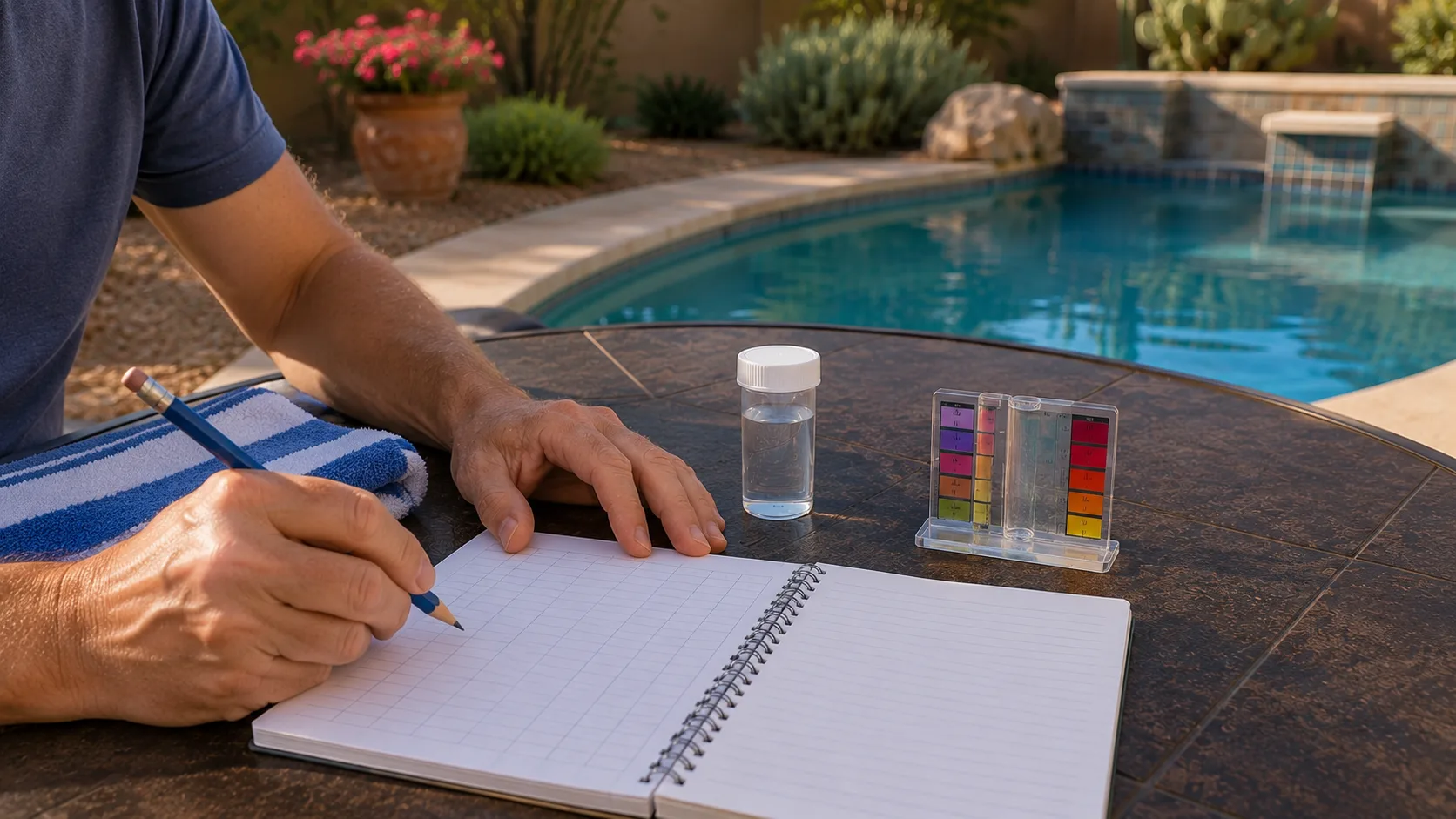
Do not start with the chemical shelf. Start with the number or color result.
Write down:
- Date and time.
- Sanitizer reading.
- pH reading.
- Weather or recent use.
- Any unusual event, such as heavy swimmers, dust storm, rain, debris, cloudy water, or recent chemical addition.
This log becomes more useful than memory. Memory turns every pool problem into "I think it was fine yesterday." A log tells you whether the water is drifting, recovering, or doing something weird.
3. Compare Against The Correct Reference
Use the reference that applies to your pool:
- Test-kit instructions.
- Chemical product label.
- Pool equipment or sanitizer-system manual.
- Pool service handoff notes, if you have them.
- Qualified pool professional guidance.
- Local public-health or code requirements if relevant.
Do not use a random chart, a neighbor's pool, or an old screenshot from another pool as the controlling source.
4. Adjust Slowly, If Adjustment Is Needed
If an adjustment is needed, follow the specific product label and pool guidance. Do not mix products together. Do not add multiple chemicals casually. Do not estimate pool volume if you are unsure and the product depends on volume. Do not add something because the water "feels off."
The safe homeowner mindset is boring in the best possible way:
- Test.
- Record.
- Read.
- Adjust according to directions.
- Circulate.
- Retest.
That rhythm is how pool chemistry becomes less dramatic.
How Often Should A Homeowner Test?
The honest answer is that a pool should be tested often enough to catch drift before it becomes a problem.
CDC's homeowner pool guidance recommends testing chlorine concentration and pH at least twice per day, and more often when the pool or hot tub is being used by a number of people. Many residential homeowners will also follow the schedule recommended by their test kit, product labels, service professional, local rules, or pool system.
For a homeowner taking over a backyard pool, testing more often at first can be helpful because it teaches you how the pool behaves.
Good times to test include:
- Before swimming.
- After heavy use.
- During very hot weather.
- After a dust storm, rain, wind event, or heavy debris load.
- After adding chemicals, according to the label and test-kit timing.
- When the water looks cloudy, dull, foamy, unusually green, or irritating.
- When the pool smells strongly of chemicals.
- When you are trying to learn the pool's weekly pattern.
Once you understand the pool, your normal routine may settle into a predictable pattern. But storms, heat, parties, algae, equipment issues, and water replacement can change that pattern fast.
Test Strips, Drop Kits, And Digital Readers
Homeowners usually run into three broad testing options:
- Test strips.
- Drop or DPD-style kits.
- Digital readers.
This is not a product recommendation. Each method has instructions, limits, shelf-life considerations, and ways to get bad results if used carelessly.
CDC notes that DPD test kits are more accurate for measuring chlorine and pH, while test strips can be used but are less accurate. For the homeowner, the practical takeaway is not "buy one specific thing." The takeaway is to understand the accuracy limits of your method and follow the directions closely.
Whatever method you use:
- Store it according to the instructions.
- Check expiration dates.
- Keep wet hands out of containers unless the instructions allow it.
- Use the right sample amount.
- Read results under the right lighting.
- Do not keep using a test that appears damaged, expired, contaminated, or inconsistent.
Chlorine Pools Versus Saltwater Pools
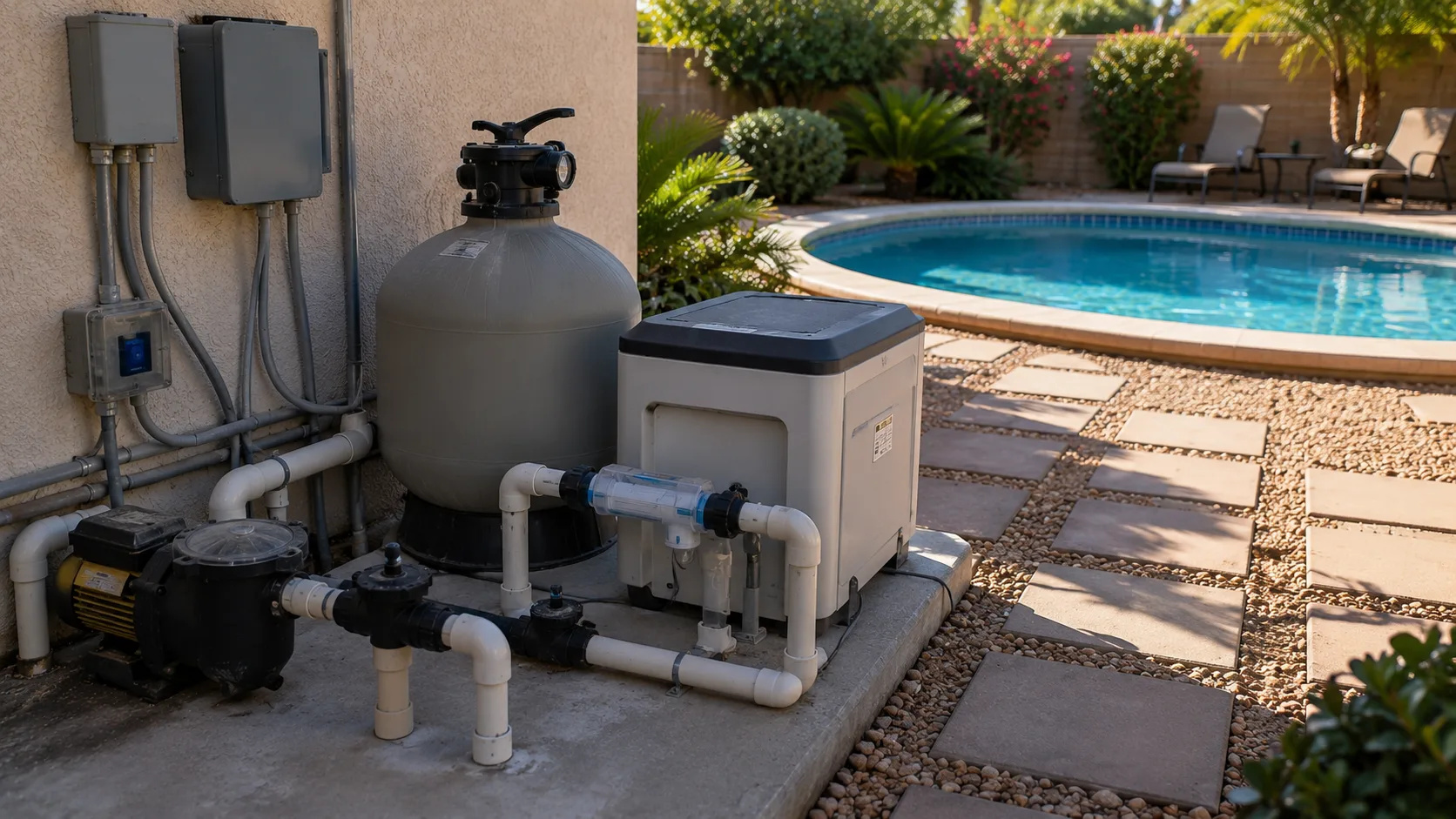
Saltwater pools still need testing.
That point is worth saying plainly because "saltwater" sounds like a different universe. A saltwater pool usually uses a salt chlorine generator to make chlorine from salt in the water. It can reduce some direct handling of chlorine products when the system is working properly, but it does not remove the need for sanitizer awareness, pH testing, water balance, circulation, filtration, brushing, and equipment attention.
For a traditional chlorinated pool, the homeowner is usually managing chlorine products more directly. For a saltwater pool, the homeowner also needs to understand salt level, generator output, cell condition, and manufacturer guidance.
In both cases:
- Test sanitizer and pH.
- Follow labels and manuals.
- Keep a log.
- Do not guess with chemicals.
- Call a pro when the system or result does not make sense.
The Testing Log That Actually Helps
Your log does not need to be fancy. It just needs to exist.
Use columns like:
- Date.
- Time.
- Free chlorine or sanitizer reading.
- pH.
- Other readings your pool system requires.
- Water appearance.
- Weather or recent use.
- What you added, if anything.
- When you retested.
- Notes for the next check.
The point is not to create homework. The point is to avoid repeating the same mistake twice because you cannot remember what you added, when you added it, or whether the water was already cloudy before the adjustment.
Beginner Mistakes That Make Testing Harder
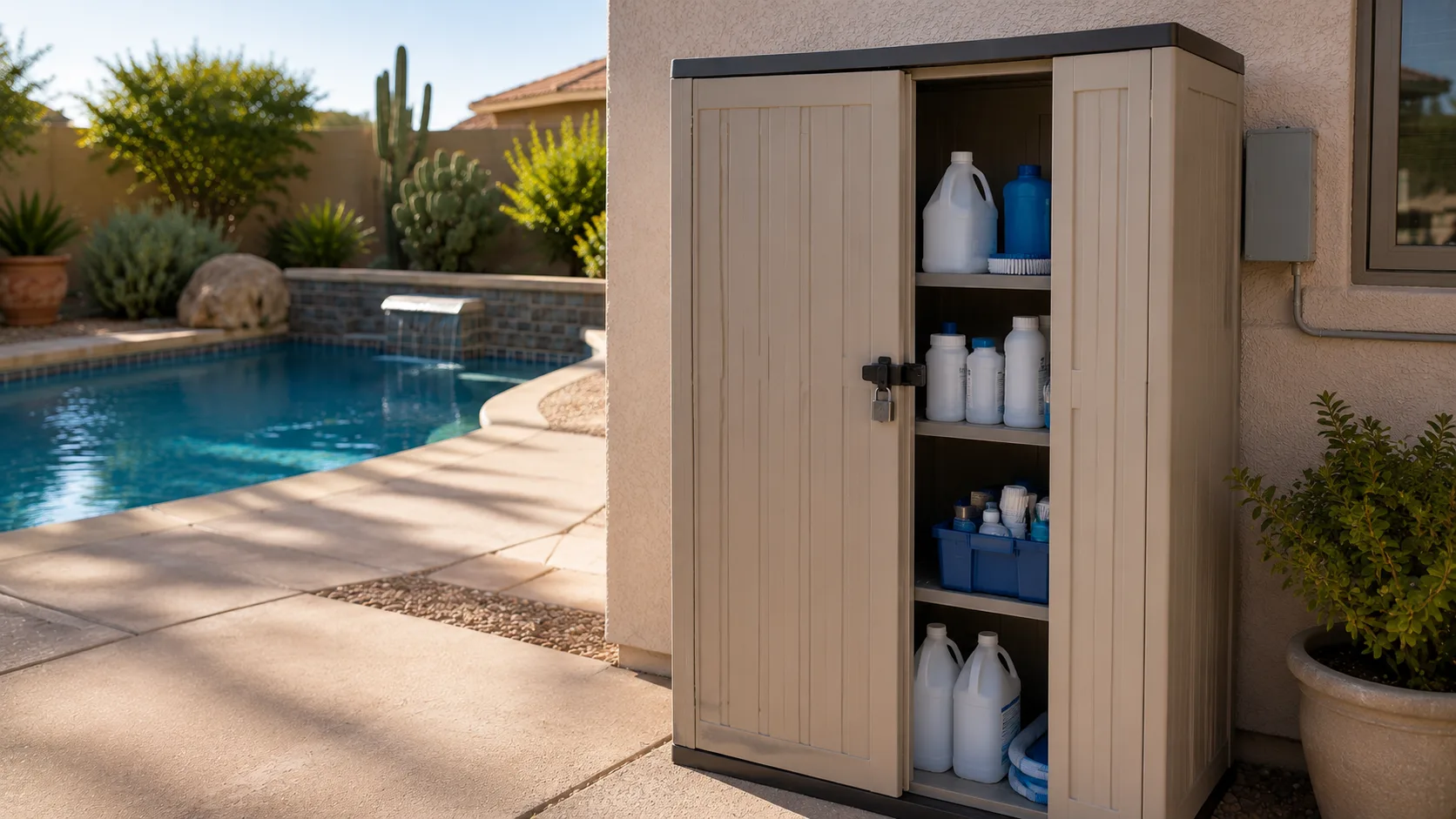
Avoid these:
- Testing once, adjusting a lot, and never retesting.
- Testing from a bad sample location.
- Reading the result too early or too late.
- Storing strips or reagents in heat, moisture, or sun when the instructions say not to.
- Treating a saltwater pool as maintenance-free.
- Adding chemicals without knowing pool volume or product directions.
- Mixing chemicals together.
- Keeping old, unlabeled, wet, or damaged pool chemicals.
- Assuming clear water is automatically safe.
- Assuming chemical smell means "too much chlorine" without testing.
The pool does not need confidence. It needs careful repetition.
When To Stop And Call A Pro
Call a qualified pool professional if:
- You cannot get a reliable test result.
- The readings do not make sense.
- The pool remains cloudy after basic care.
- Algae appears or keeps returning.
- The water irritates eyes, skin, or breathing.
- You are unsure what chemicals were added.
- Chemicals are wet, damaged, unlabeled, mixed, or stored poorly.
- Equipment is not circulating water normally.
- A salt chlorine generator reports errors or behaves inconsistently.
- You need surface-specific, stain, scale, leak, electrical, or equipment repair guidance.
There is no shame in using a professional for diagnosis, a seasonal reset, or a confusing chemistry problem. The goal is not to prove you never need help. The goal is to know which parts of pool care you can do calmly and which parts need backup.
The Bottom Line
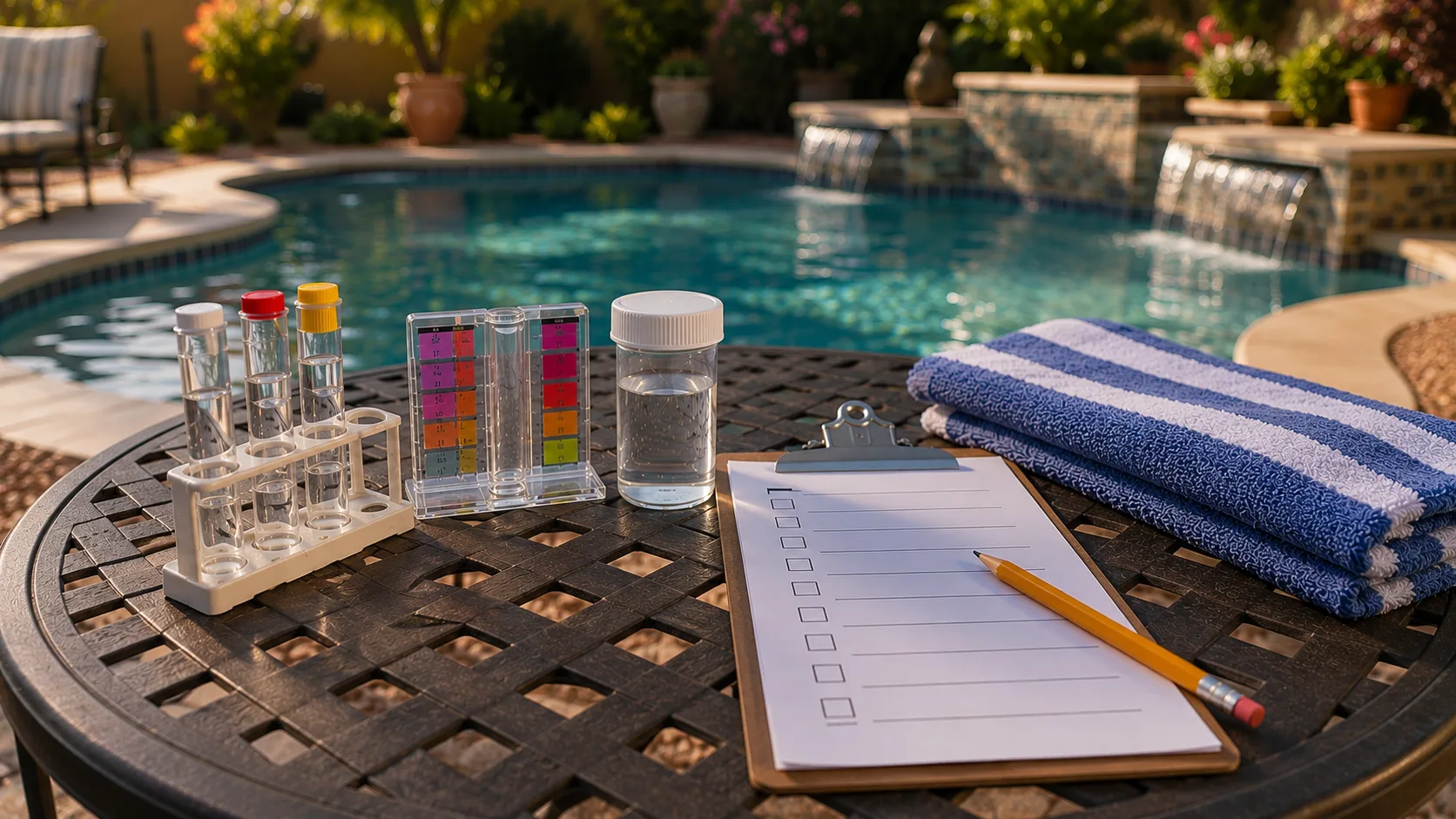
Pool testing gets easier when it becomes a routine instead of a guessing session. Test the same way, write it down, compare the result to the right instructions, make one deliberate adjustment at a time, and retest.
That is the demystifying move. Not memorizing every chemical. Not buying every gadget. Just building a repeatable loop that keeps you from panicking, guessing, or turning a simple water check into a chemistry incident.