
The front yard has a harder job than the backyard. The backyard can be private, weird, experimental, or still waiting for someone to make decisions after coffee. The front yard has witnesses.
That is why a low-water front yard cannot simply be a lawn replacement with better intentions. If the yard becomes a flat field of gravel with a few small plants scattered like afterthoughts, it may technically use less water, but it also announces that the house has given up on greeting people.
A good low-water front yard should feel finished from the street, welcoming from the sidewalk, comfortable at the entry, and sensible for the climate. It needs paths, planting rhythm, shade where possible, material restraint, and a reason for the eye to move toward the front door. Gravel can help. Gravel cannot carry the whole social life of the house.
The Direct Answer
The best low-water front yards start with the entry experience, not the groundcover.
Before choosing gravel, decomposed granite, mulch, plants, boulders, or edging, decide how someone should move from the street or driveway to the front door, what views matter from inside the house, which areas need shade or softness, and where planting should create structure. Then use repeated plant groups, clear paths, anchor plants, material boundaries, and a controlled amount of open gravel or decomposed granite to make the yard feel intentional.
If your yard already looks thin or random, Xeriscape Layout Mistakes That Make Yards Look Sparse is the closest companion. If you are still choosing plants, How to Choose Plants for a Low-Water Landscape explains why plant roles matter more than impulse buying.
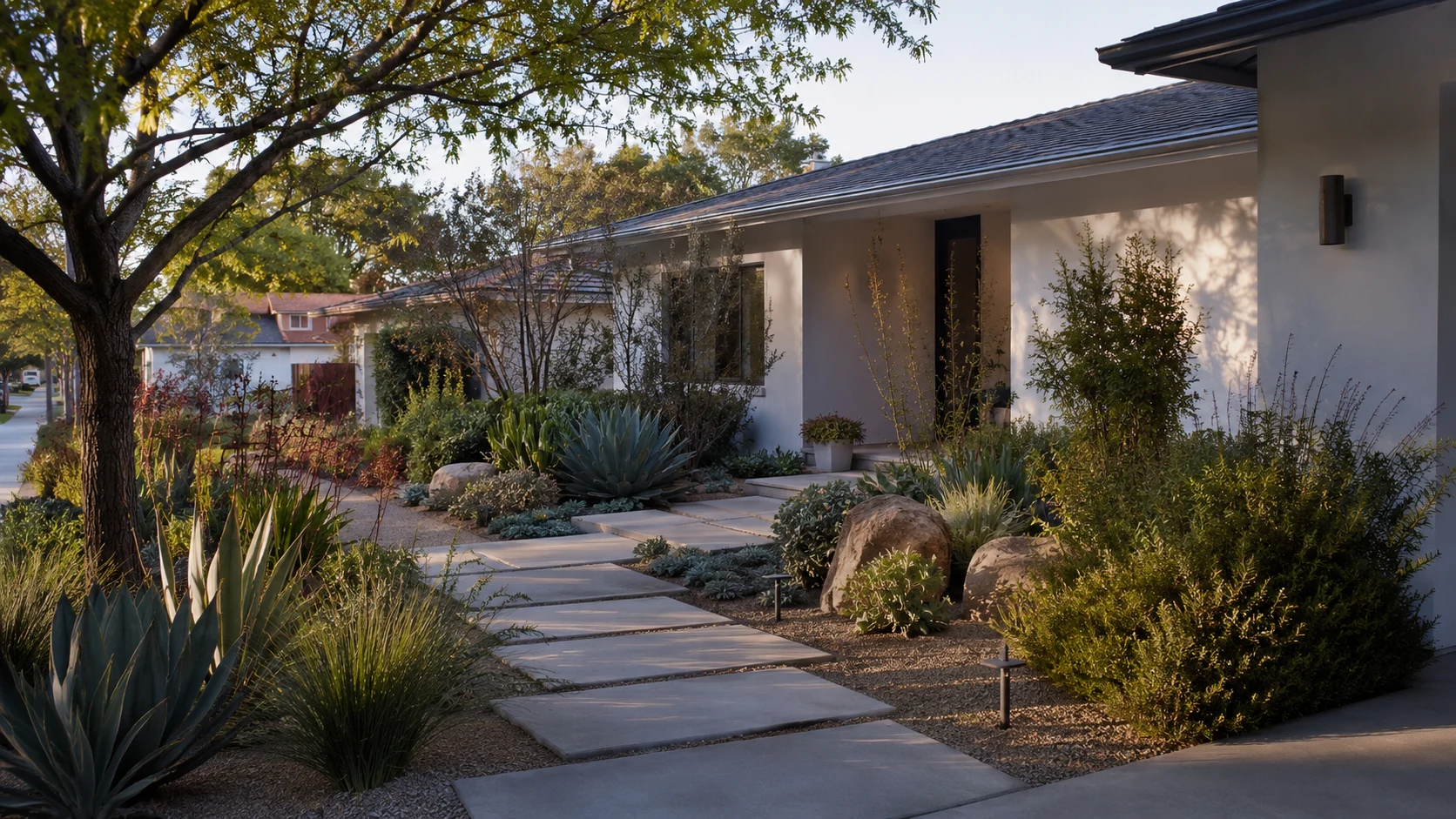
Start With The Front Yard's Job
A front yard is not just "the space in front of the house." It usually has several jobs:
- Help people find the front door.
- Make the house look cared for from the street.
- Frame the driveway, walkway, porch, windows, or entry.
- Soften walls, corners, and hardscape.
- Handle sun, reflected heat, wind, and maintenance.
- Keep utility access, trash routes, gates, and sightlines workable.
- Show some personality without creating a maintenance opera.
The mistake is treating all of that as a surface problem. A front yard is not fixed by swapping grass for rock. It is fixed by deciding what the yard should do, then choosing materials and plants that support that job.
Two yards can use the same amount of gravel. One looks calm and architectural. The other looks like a vacant lot dressed for a homeowner association meeting. The difference is layout.
Make The Front Door Obvious
If visitors have to guess how to reach the front door, the yard is already working too hard.
The entry path should be clear from the street, driveway, or sidewalk. It does not need to be formal, expensive, or ruler-straight. It does need to feel intentional. A path can curve, widen, narrow, pass through planting, or cross gravel. But it should not disappear into decorative rock like a rumor.
Good front-yard path moves:
- Keep the walking line legible from the street.
- Make transitions from driveway, sidewalk, or curb feel natural.
- Use planting to frame the path, not crowd it.
- Avoid loose materials that migrate onto steps or thresholds.
- Keep trip edges, awkward grade changes, and slippery surfaces out of the main entry route.
- Leave room for real use: guests, deliveries, kids, strollers, luggage, groceries, and the person carrying too many things because one trip is a lifestyle.
If a path crosses decomposed granite, gravel, pavers, or stepping stones, think about stability and maintenance before aesthetics. A front entry is not the place for a surface that looks great in a photo but behaves like a tiny obstacle course.
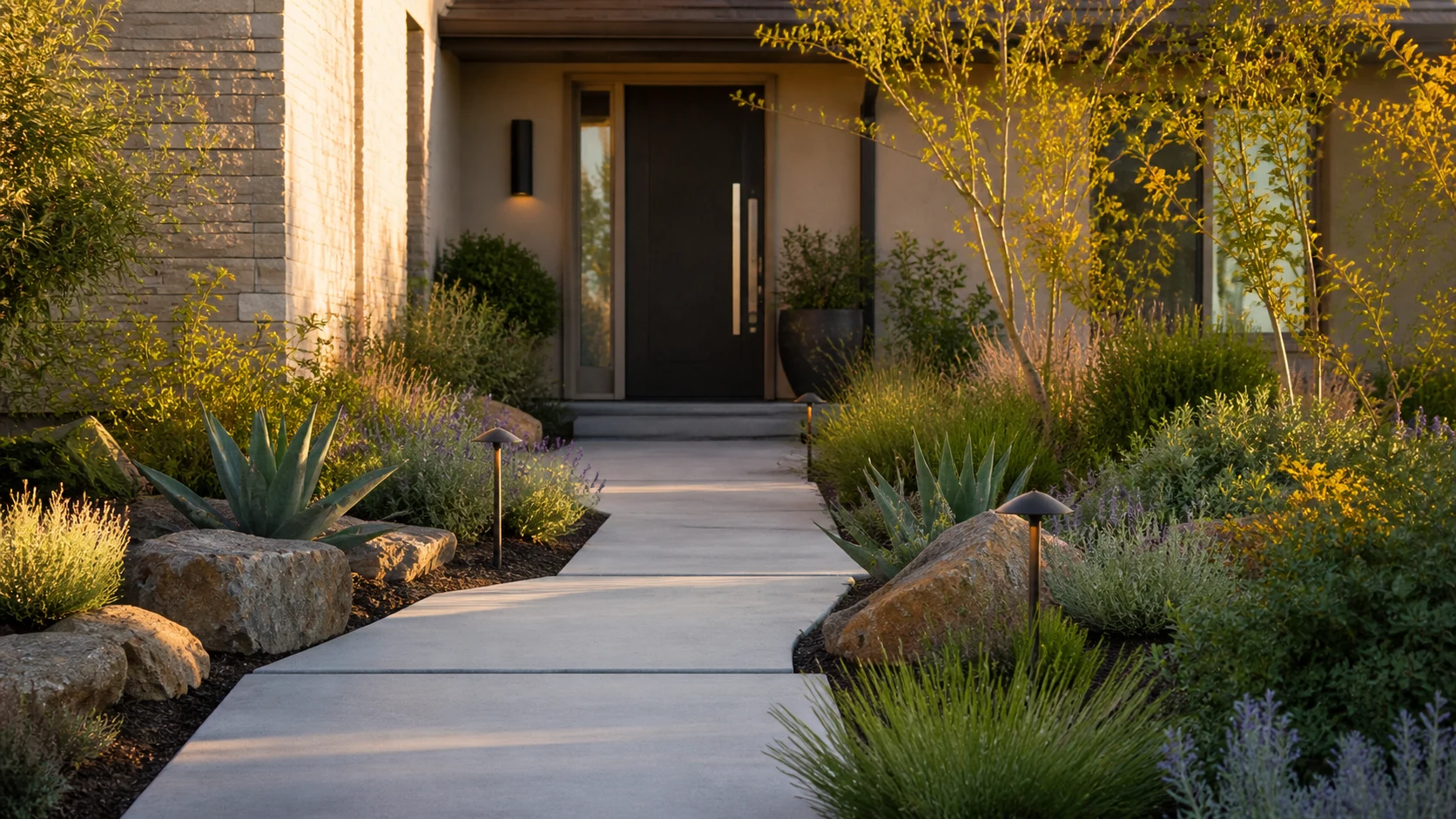
The Curb View Matters More Than The Plant Tag
Most front yards are judged first from across the street. That view is blunt. It does not care that a plant was interesting at the nursery. It sees shape, mass, void, line, and whether the yard feels connected to the house.
Stand at the curb and ask:
- Does the yard have a clear foreground, middle, and background?
- Is the front door or porch visually supported?
- Are the plants grouped enough to read as a design?
- Is gravel acting as background, or is it the main event?
- Does the house look grounded, or does it look like it landed in a rock tray?
- Are windows, corners, and blank walls softened?
This is where low-water front yards often go sideways. The homeowner chooses sensible plants and durable groundcover, but from the street the yard reads as empty because everything is too small, too far apart, too low, or too unrelated.
The fix is not always more plants. Sometimes it is stronger plant groups, cleaner bed shapes, a more obvious path, a small tree where locally appropriate, or one good anchor at the right corner.
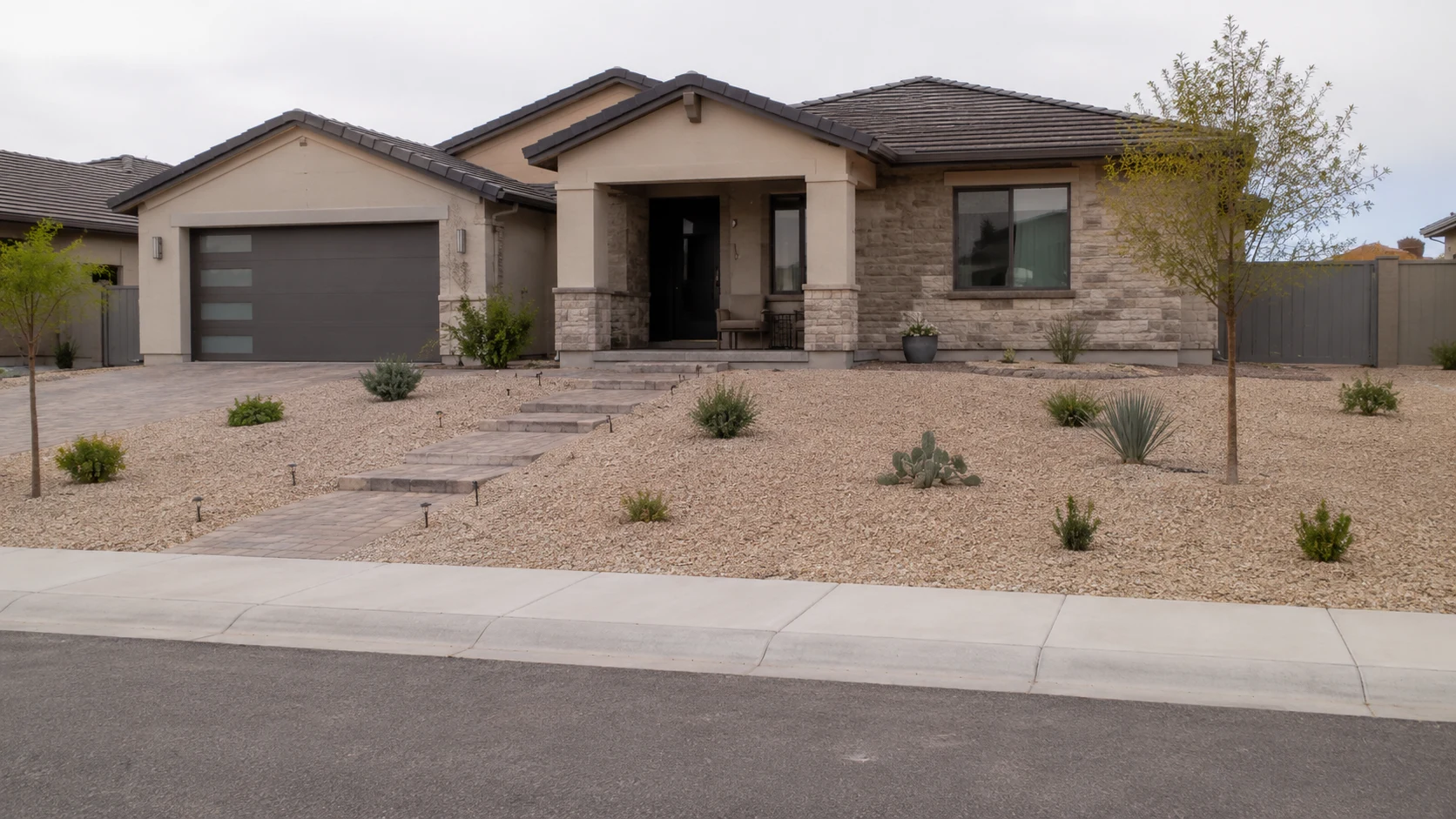
Use Gravel Like Background Music
Gravel can be beautiful in a front yard. It can also become the landscape version of holding one note for three minutes.
Use gravel, crushed rock, or decomposed granite where it has a job:
- Connecting paths and planting beds.
- Creating a calm ground plane around stronger plant groups.
- Reducing mud or dust where foot traffic is light.
- Defining dry garden areas.
- Framing boulders, steps, walls, or entry features.
- Supporting a lower-water design where plant spacing and shade still matter.
Do not use gravel as a substitute for design. A front yard that is 85 percent exposed rock and 15 percent lonely plants usually looks unfinished, hot, and temporary. It may be technically complete, but emotionally it is still in a waiting room.
If you are choosing between organic mulch, gravel, and mixed materials, Mulch vs Gravel in Low-Water Landscapes covers the tradeoffs. The front-yard version is simple: use mineral materials for structure and access, then make planting beds feel alive enough that the yard does not read as decorative parking.
Build A Few Strong Plant Masses
Low-water does not mean one plant of everything. Especially not in the front yard.
From the street, small individual plants often disappear. A single grass, a single flowering perennial, a single sculptural accent, and a single mounding shrub can all be good plants and still look like a random collection. Repetition gives the yard rhythm.
Better moves:
- Use three, five, or more of a plant type where the space and mature size allow.
- Repeat a plant shape on both sides of a path or across the front of a bed.
- Use fewer plant types in stronger groups.
- Combine anchors, fillers, accents, and ground-level softness.
- Let accents be accents, not the entire cast.
This is not a universal spacing rule. Mature size, local climate, water needs, sun exposure, and maintenance all matter. The point is composition: a front yard should read as a landscape from the street, not a plant shopping receipt.
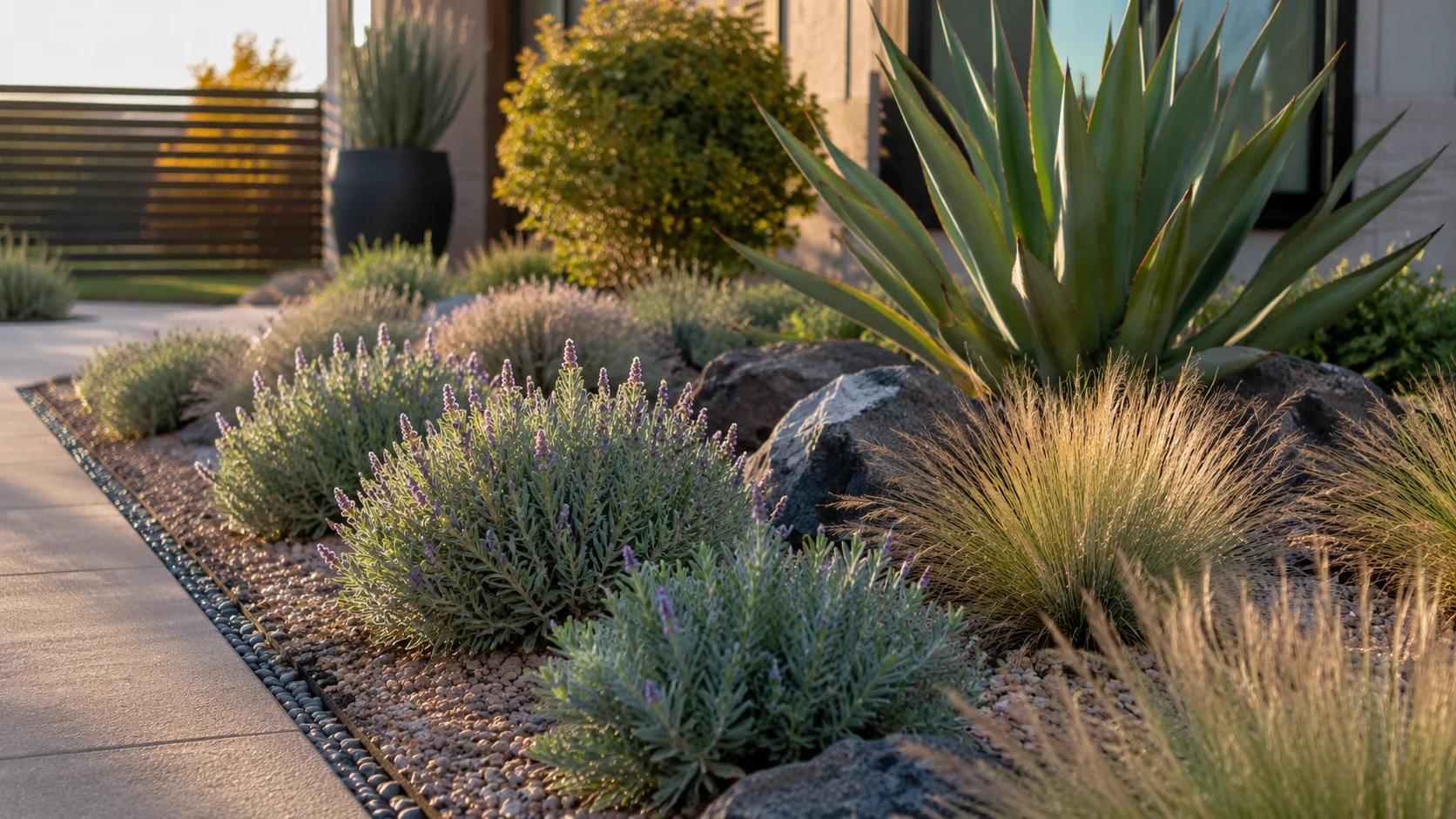
Give The Yard A Middle Layer
Many low-water front yards look sparse because they have only two layers: rock on the ground and small plants barely above it.
A stronger front yard usually needs a middle layer. That could mean medium shrubs, upright grasses, larger mounding plants, wall-softening plants where appropriate, or small trees and larger shrubs where the site can support them. The exact species should come from local guidance, not from a national article pretending every climate is one big patio.
Middle-layer plants do useful work:
- They soften house corners.
- They make windows feel framed instead of exposed.
- They add privacy without turning the yard into a hedge bunker.
- They help paths feel enclosed and welcoming.
- They make smaller plants look intentional.
- They reduce the visual dominance of gravel.
Do not plant large shrubs or trees casually near foundations, utilities, rooflines, sidewalks, or driveways. Mature size, roots, clearance, irrigation, and local suitability matter. For mature trees or major structural planting decisions, check local extension offices, reputable nurseries, arborists, water providers, or qualified landscape designers.
Frame The House, Not Just The Yard
Front-yard design is partly landscape and partly architecture.
Look at the house first. Where are the blank walls? The awkward corners? The porch that looks too exposed? The windows that need softness? The garage that dominates everything like it has appointed itself mayor?
Planting can rebalance the house:
- Use anchors near corners to ground the facade.
- Place lower planting near windows where views and clearance matter.
- Frame the entry path so the door feels important.
- Add softness near steps, walls, or porch edges.
- Use repeated groups to connect driveway, walkway, and planting beds.
- Keep plants away from areas where they block visibility, scrape walls, or make maintenance annoying.
The yard should make the house look more settled. If the landscape has no relationship to the architecture, the front yard can feel like a separate project that wandered onto the property.
Think From Inside The House Too
The street view matters. So does the view from the kitchen window, front room, office, or porch.
Many low-water front yards are planned as if the only audience is a person standing on the sidewalk. But you may see the yard from inside every day. That view deserves a little generosity.
Good window-view questions:
- Do you see planting, or mostly rock?
- Is there movement from grasses or seasonal plants?
- Does a path or bed shape create depth?
- Are blank walls or utility areas softened?
- Does the yard look good when nothing is blooming?
- Are plants placed where mature size will block light, scrape glass, or trap debris?
This is where a small amount of thoughtful planting can do more than a large amount of decorative rock. A layered bed below a window can make the whole front of the house feel calmer.
Add Shade Carefully
Shade is one of the biggest differences between a front yard people admire and a front yard people hurry past.
A small tree, multi-trunk shrub, porch shade, architectural overhang, or carefully placed vertical planting can make the entry feel less exposed. Shade can also help reduce harsh glare from rock and hardscape. But shade decisions are local and long-term. Trees grow. Roots grow. Branches move. Utilities and roofs do not politely relocate themselves.
Use shade thinking, not shade fantasy:
- Identify the hottest exposures.
- Notice west-facing walls, windows, and entry paths.
- Think about mature size before planting.
- Keep clearance around doors, walks, driveways, utilities, and sightlines.
- Match plants to sun, reflected heat, soil, and water needs.
- Get local guidance for tree selection and placement.
For the comfort side of this decision, Shade in Low-Water Landscapes gives the broader framework.
Put Water Needs In Groups
The front yard may look like one design, but irrigation should not treat every plant like it has the same personality.
Group plants by similar water and sun needs. This is the plain-English version of hydrozoning: plants that want similar conditions should live together when practical, so they can be watered and maintained more sensibly.
This matters in front yards because entries, walls, driveways, reflected heat, shade pockets, and street edges can behave very differently. A plant near a hot driveway may live in a different microclimate from a plant beside a shaded porch.
Do not copy a universal watering schedule from an article. Establishment, soil, plant type, season, irrigation method, and local rules all matter. Use Hydrozoning Basics for Homeowners and Drip Irrigation Basics for Low-Water Yards for the concept, then verify local requirements and professional guidance where needed.
Use Edges To Make It Look Finished
Edges are the difference between "intentional transition" and "materials slowly negotiating a border dispute."
A low-water front yard may include gravel, decomposed granite, organic mulch, concrete, pavers, porch steps, lawn remnants, or planting beds. If those materials bleed into one another, the yard looks unfinished no matter how nice the plants are.
Useful edge strategies include:
- A clean border between gravel and mulch.
- A path edge that keeps loose material out of the walking surface.
- Bed shapes that are simple enough to maintain.
- A transition between driveway and planting that does not create a trip edge.
- A clear boundary where front-yard planting meets sidewalk or curb.
Concrete, pavers, stone, metal, or flexible edging can all work depending on the site. Do not treat edging as a retaining wall, drainage fix, root solution, or code workaround. For concrete-specific edge decisions, Concrete Edging for Gravel, Mulch, and Planting Beds covers what edging can and cannot solve.
Three Front Yard Scenarios
The Former Lawn, Now Mostly Rock
The grass is gone. The water use is lower. The front yard also looks like a utility company staging area.
Start by adding shape. Define a stronger entry path, create planting beds with enough depth to matter, and group plants instead of scattering them across the whole yard. Use gravel as the negative space between planted areas, not as the main design.
This yard may not need more stuff. It needs hierarchy.
The Driveway-Dominated Yard
Some front yards are mostly garage, driveway, and a narrow strip of planting asked to perform miracles.
Here, the goal is not pretending the driveway is invisible. The goal is softening its edges and giving the eye a better destination: a clear entry path, repeated planting beside the drive, a stronger porch edge, or an anchor plant that pulls attention away from the garage door.
Keep visibility and access practical. A beautiful plant in the wrong sightline is not a design win.
The Tiny Front Yard With Big Ambitions
Small front yards do not need tiny versions of every idea.
Choose one strong path, one or two plant masses, one anchor, and a clean material palette. Avoid five groundcovers, three rock colors, two edging styles, and a plant collection behaving like it is late for separate meetings.
Small yards reward restraint. They punish decorative indecision immediately.
Common Mistakes
The usual front-yard failures are surprisingly consistent:
- Removing lawn without designing the entry.
- Using too much exposed gravel.
- Planting one of everything.
- Making the path unclear or uncomfortable.
- Ignoring the view from the street.
- Ignoring the view from inside the house.
- Choosing plants by nursery size instead of mature size.
- Forgetting shade and vertical layers.
- Making the yard look empty while plants mature.
- Using boulders with no relationship to bed shape or planting.
- Creating trip edges near walks, driveways, or steps.
- Mixing plants with very different water needs.
- Treating edging as a fix for drainage, slope, root, or structural problems.
- Choosing a design that only looks good for one bloom season.
The theme is not "never use gravel" or "plant everything densely." The theme is: give the front yard a clear job, then make every material and plant earn its place.
Homeowner Checklist
Before changing the front yard, walk it in this order:
- Stand across the street. What reads first: the entry, the garage, the gravel, or the plants?
- Walk from the curb, sidewalk, and driveway to the front door. Is the route obvious and comfortable?
- Look from inside the house. Which views need softness, movement, or structure?
- Identify hot walls, reflected heat, shade pockets, and windy spots.
- Decide where gravel, mulch, decomposed granite, pavers, or planting should actually do a job.
- Choose plant roles before species: anchors, fillers, accents, ground-level softness, and seasonal interest.
- Group plants by similar water and sun needs.
- Check mature size, root space, visibility, utilities, doors, windows, and maintenance access.
- Add clean edges where materials meet.
- Ask local experts about plant suitability, water rules, rebates, HOA questions, and tricky site conditions before making claims or commitments.
FAQ
Can a low-water front yard still have curb appeal?
Yes. Curb appeal comes from clear layout, healthy planting, good paths, visible entry, scale, repetition, shade, and clean material transitions. A front yard does not need a large lawn to look cared for.
Is gravel bad for front yards?
No. Gravel can be useful as a background material, path surface, or dry-climate design element. It becomes a problem when it replaces layout, planting, shade, and edges. Too much exposed rock can look harsh and unfinished, especially with small isolated plants.
Should I remove all front-yard lawn at once?
Not always. A phased conversion can be smarter if the current lawn still has useful areas, the irrigation plan is unclear, or the replacement design is not ready. Start with the least useful lawn area and make that section look intentional.
What plants should I use in a low-water front yard?
Choose plant roles first, then species. You may need anchors, repeated fillers, accents, lower plants, seasonal interest, or shade. Final species should come from local extension offices, water providers, botanical gardens, reputable nurseries, qualified designers, or arborists who understand your climate and site.
How do I keep a xeriscape front yard from looking empty while plants grow?
Use repeated plant groups, clear bed shapes, mulch or gravel with a purpose, clean edging, boulders or structural elements where appropriate, and enough planting scale to read from the street. Do not rely on tiny isolated plants to carry the yard for the first few years.
Do low-water front yards save water?
They can reduce outdoor water use when designed and maintained well, but savings depend on climate, plant choices, irrigation, soil, maintenance, existing lawn area, and local conditions. Avoid guaranteed savings claims. Plan carefully and follow local water provider guidance.
Bottom Line
A low-water front yard should not look like someone deleted the lawn and forgot to install the idea.
Start with the entry. Shape the view from the street. Use gravel as background, not the whole performance. Repeat plants, add middle layers, soften the house, group water needs, and make the path to the door feel deliberate.
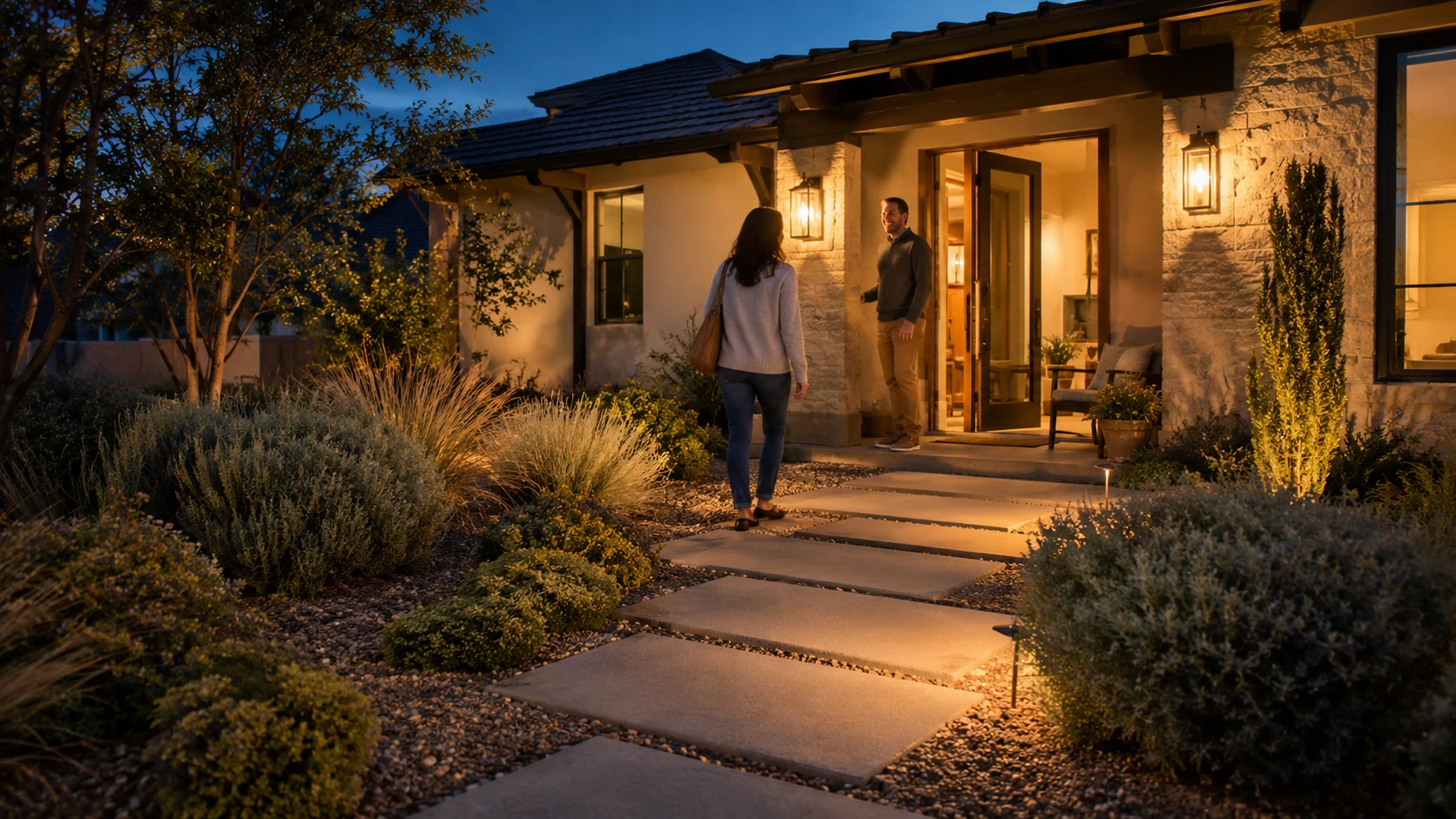
The front yard does not need to be lush everywhere. It does need to look like somebody meant it.