
A fence line can make a planting bed look easy. It is a straight edge, after all. How much trouble can one long strip of dirt cause?
Plenty.
Fence-line beds are where reflected heat, narrow soil, awkward shade, irrigation drift, root competition, gates, utilities, and maintenance access all gather for a little neighborhood meeting. Then someone adds a row of tiny plants, a blanket of hot gravel, and optimism. By July, the bed looks less like waterwise design and more like a plant endurance test.
A good hot fence-line planting bed is not just a leftover strip. It is a microclimate. Treat it that way and it can become one of the most useful parts of the yard: a softer edge, a better patio backdrop, a calmer side yard, a screen for harsh walls, and a low-water planting zone that looks intentional instead of scorched.
The Direct Answer
Design a hot fence-line planting bed by solving the microclimate first and the plant list second.
Notice the sun exposure, reflected heat, fence material, shade pattern, wind, soil space, access needs, and irrigation zone before choosing plants or groundcover. Then use repeated plant groups, layered heights, mulch or gravel by job, clear edges, and enough mature-size room to keep the bed from becoming a thin row of lonely plants. Keep utilities, gates, walls, fences, and maintenance access clear.
If you are still choosing plants, start with How to Choose Plants for a Low-Water Landscape. If the bed already looks sparse or random, Xeriscape Layout Mistakes That Make Yards Look Sparse explains the bigger layout problem.
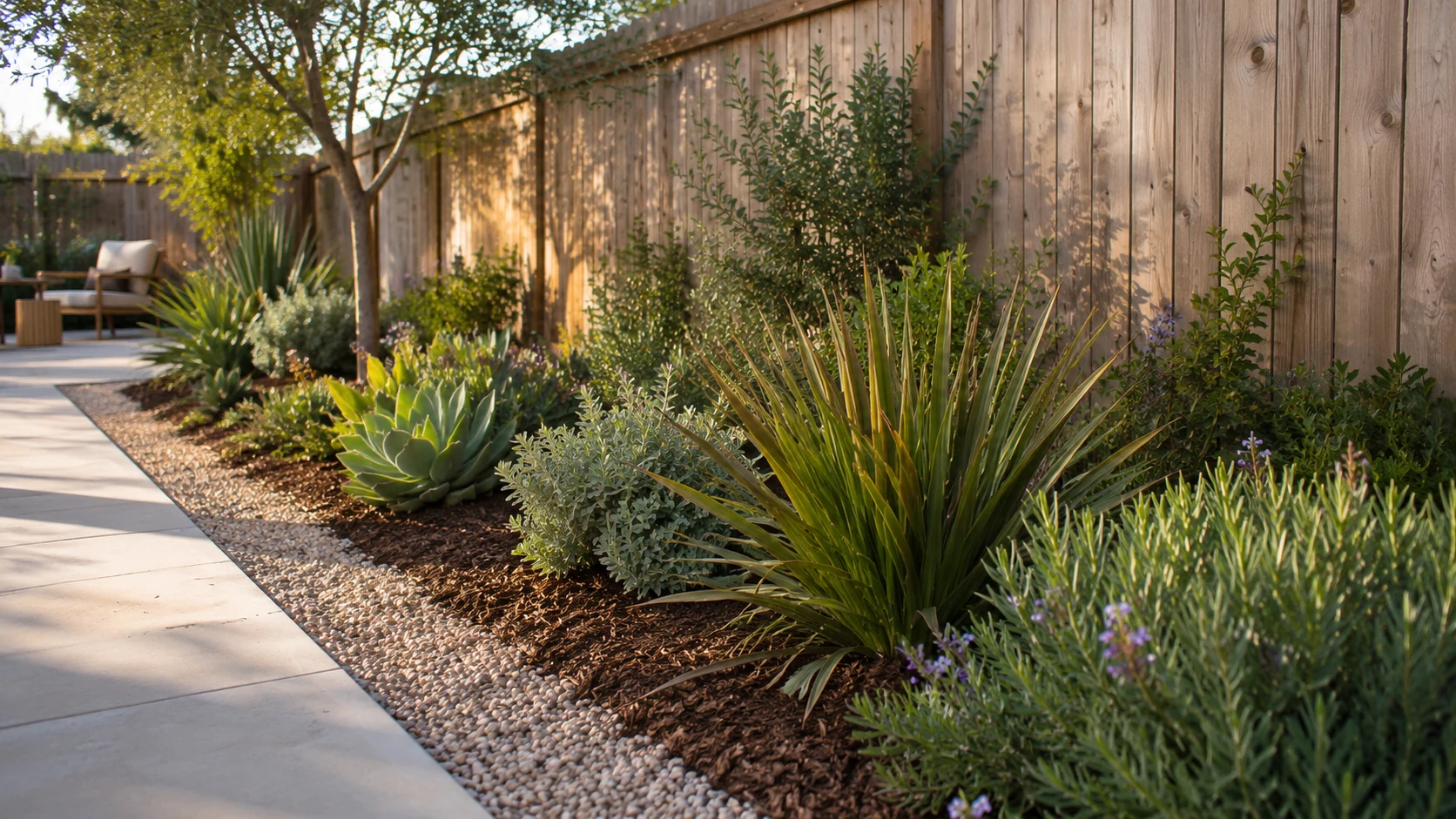
Why Fence Lines Are Meaner Than They Look
Fence lines and walls create harsher conditions than many open planting beds.
They can reflect heat back onto plants. They can block airflow. They can create a narrow strip of shade in the morning and a brutal wall of afternoon heat later. They can hide dry spots where irrigation misses. They can collect windblown debris. They can also sit next to patios, paths, gates, dogs, hoses, trash routes, pool equipment, utility boxes, or neighbors who can see every design decision.
That does not mean the bed is doomed. It means the bed needs a plan.
Start by asking:
- Is the fence or wall reflecting afternoon heat?
- Is the bed narrow, deep, or irregular?
- Does the area get full sun, part shade, or shifting shade?
- Is there a gate, hose bib, utility, meter, drain, cleanout, or access panel nearby?
- Does water run toward the house, fence, path, or patio?
- Will plants need to stay clear of a walkway, side yard, or seating area?
- Is the bed mostly a view, a screen, a passage, or a patio backdrop?
That last question matters. A fence-line bed along a dining patio has a different job than a bed behind trash bins.
Do Not Plant A Tiny Parade
The most common fence-line mistake is the tiny parade: one small plant every few feet, marching along the fence with no depth, no rhythm, and no relationship to the rest of the yard.
It looks tidy for about twelve minutes. Then it looks thin.
A better fence-line bed usually needs groups, not a lineup. Even in a narrow bed, repeated clusters can create mass. A group of three or five plants placed with mature size in mind will usually read stronger than ten unrelated plants evenly spaced like fence posts.
Think in short scenes:
- A repeated shrub group behind a patio.
- A softer low layer along the front edge.
- A taller anchor near a corner, gate, or blank wall where locally appropriate.
- A few accents placed where the eye should pause.
- Open space used deliberately, not because nobody knew what else to do.
You are not trying to cover every inch. You are trying to make the bed read as designed from the patio, path, window, or street.
Reflected Heat Changes The Planting Logic
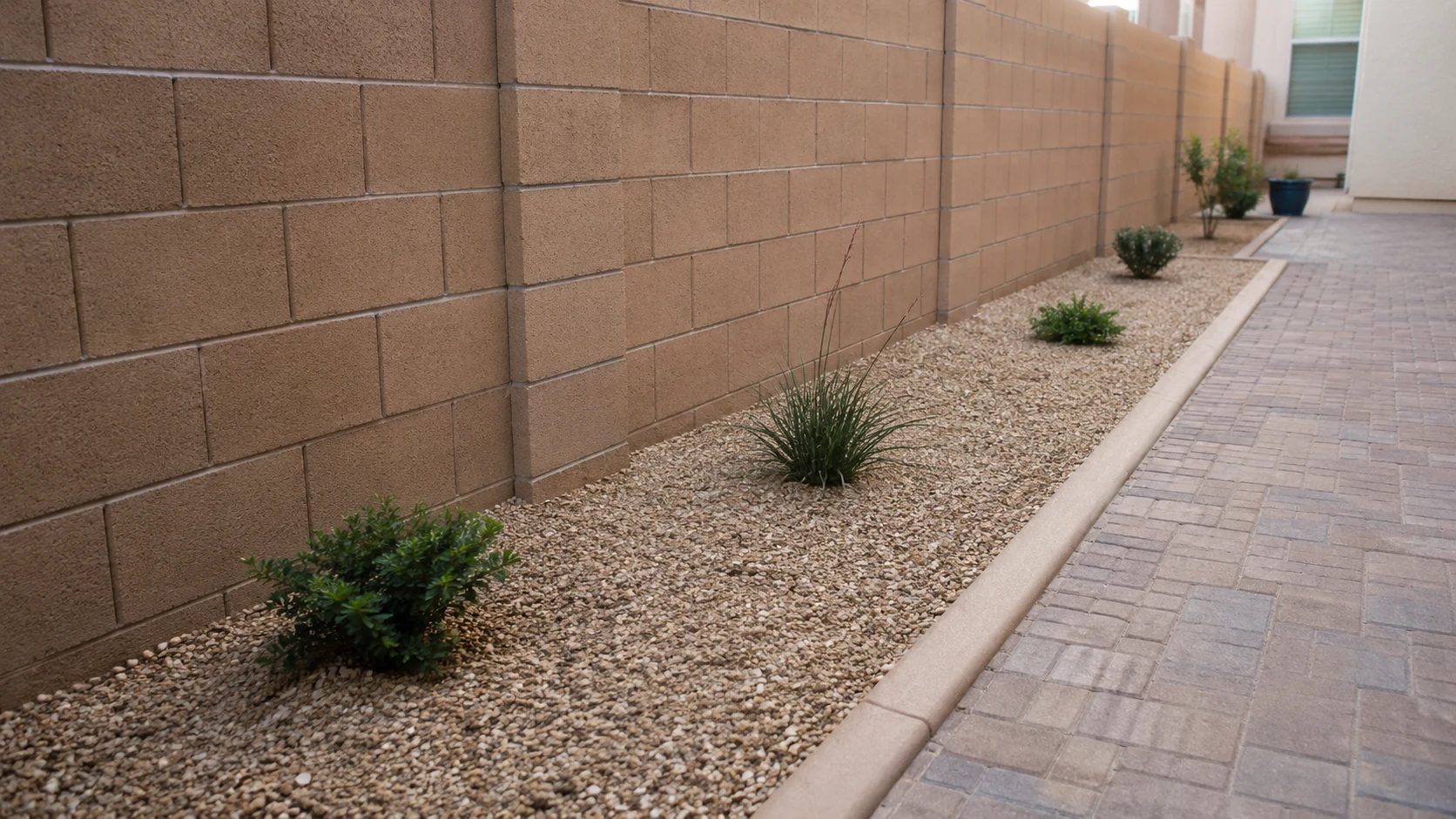
A plant that performs well in open sun may struggle beside a hot wall or fence. Reflected heat can make the air and surface conditions harsher, especially near masonry, stucco, metal, concrete, gravel, pavers, and west-facing exposures.
That changes the design logic:
- Give young plants enough establishment care without pretending there is one universal watering schedule.
- Avoid placing delicate plants in the hottest reflected-heat strip unless local guidance supports it.
- Use plant massing and groundcover to reduce the "hot bare edge" feeling.
- Be careful with large expanses of decorative rock near roots and walls.
- Consider shade from existing trees, structures, or taller planting where the site can support it.
Do not make the fence-line bed prove a point about toughness. A plant can be drought-tolerant and still dislike being baked against a wall.
For broader comfort planning, Shade in Low-Water Landscapes is the companion guide.
Use Depth, Even In A Narrow Bed
Narrow beds are not automatically bad. Flat beds are.
If the bed is shallow, depth has to come from layering, not square footage. Use plants with different heights, forms, and textures so the bed has a front, middle, and back. The exact species should come from local guidance, but the roles are universal enough:
- A back layer to soften the fence or wall.
- A middle layer to create mass.
- A front layer to soften the edge near gravel, mulch, path, or patio.
- Occasional vertical accents where they do not block access.
- Open patches only where they feel intentional.
This is also where mature size matters. A plant that looks polite in a nursery pot may later swallow a narrow path, scrape a fence, block a gate, or make maintenance miserable. Plan for the grown-up plant, then make the early years look deliberate with mulch, repeated groups, clean edges, and a sensible material palette.
Choose Groundcover By Zone, Not Habit
Fence-line beds often get the default treatment: gravel everywhere, because gravel feels low-water and decisive.
Sometimes gravel is useful. Sometimes it turns the bed into a heat reflector with plants as decoration.
Use groundcover by job:
- Organic mulch can soften planting zones and protect soil where appropriate.
- Gravel can work as a clean mineral background, especially where debris, drainage, or style supports it.
- Decomposed granite can make sense near paths or transitions, but it is not a universal planting-bed blanket.
- Mixed materials can work well when the bed has a clear edge and each material has a purpose.
The key is not choosing one heroic material. The key is not making the root zone, path edge, and patio backdrop all solve the same problem badly.
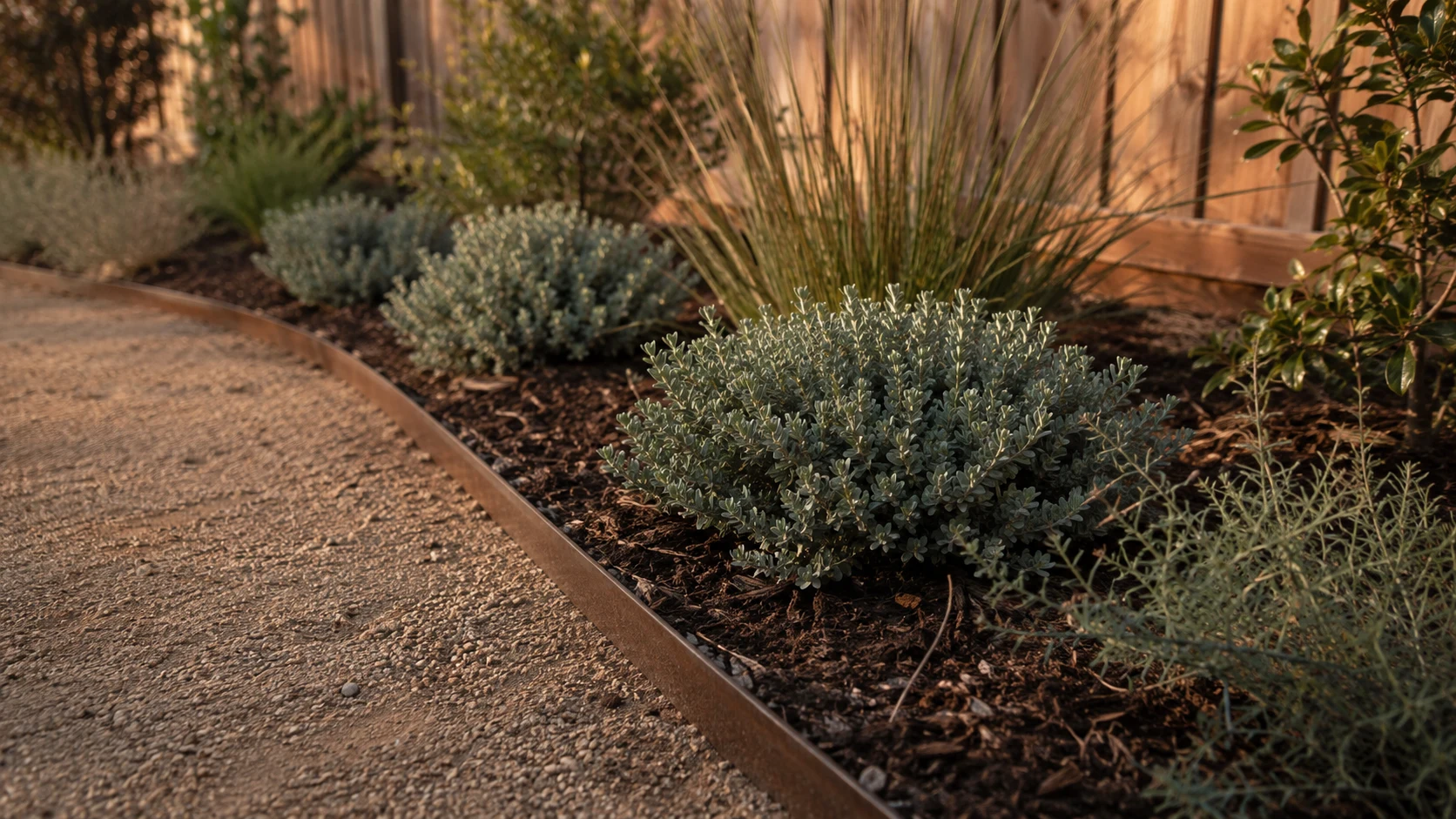
If you are still sorting materials, Mulch vs Gravel in Low-Water Landscapes, What Is Decomposed Granite?, and How to Use Decomposed Granite Without Tracking Dust Into the House can keep the ground layer honest.
Keep The Fence Usable
A fence-line bed still has to coexist with the fence.
You may need to open gates, repair boards, repaint or maintain a wall, reach irrigation, move bins, clean debris, or keep plants from leaning into a neighbor's space. A planting bed that looks pretty for one season but blocks every practical task is not finished. It is just inconvenient with foliage.
Leave practical access around:
- Gates and latch swings.
- Utility boxes, meters, valves, cleanouts, and hose bibs.
- Fence posts, panels, and wall surfaces that need maintenance.
- Pathways and side-yard circulation.
- Patio edges where people sit, stand, or carry food.
- Existing tree roots and root zones.
For tight passages, Low-Water Side Yard Ideas covers the access-first version of this problem.
Hydrozones Still Matter In A Skinny Strip
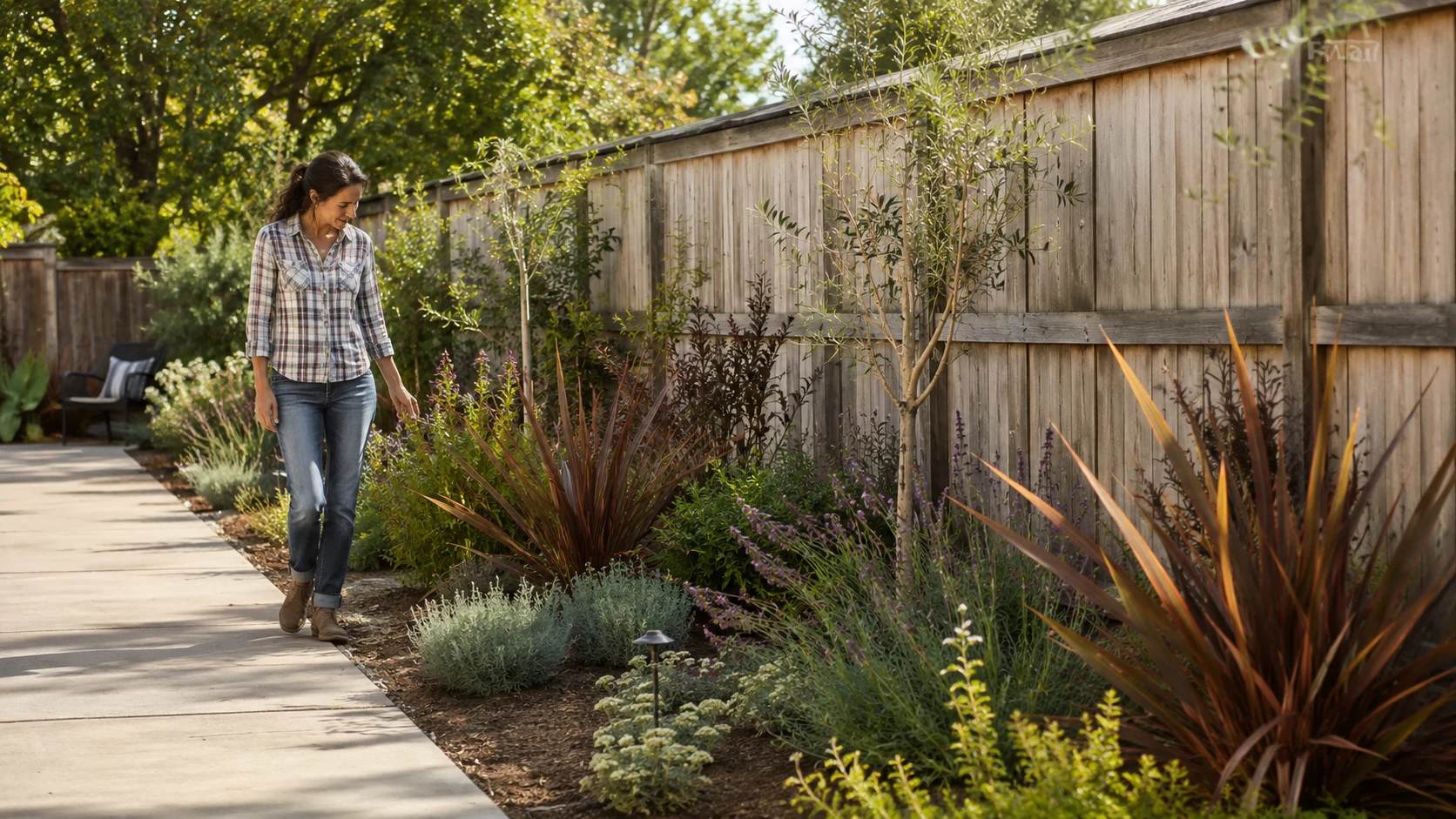
Narrow beds tempt people into treating the whole line as one watering zone. Sometimes that works. Often it does not.
The sunny end of the fence may be harsh and reflective. The end near the house may be shaded. A section under an existing tree may have root competition. A patio edge may heat up from pavers. A gate area may need clear access and fewer plants. Those are not identical conditions just because they are attached to the same fence.
Group plants by similar water and sun needs where practical. Plan establishment watering separately from long-term watering. Watch new plants closely in the first seasons. Do not use a national article as an irrigation schedule.
Hydrozoning Basics for Homeowners explains the grouping logic, and Drip Irrigation Basics for Low-Water Yards covers the homeowner-level irrigation concepts. For valves, pressure, emitter counts, backflow, local rules, or complicated retrofits, use an irrigation professional or local water provider guidance.
The Patio Backdrop Moment
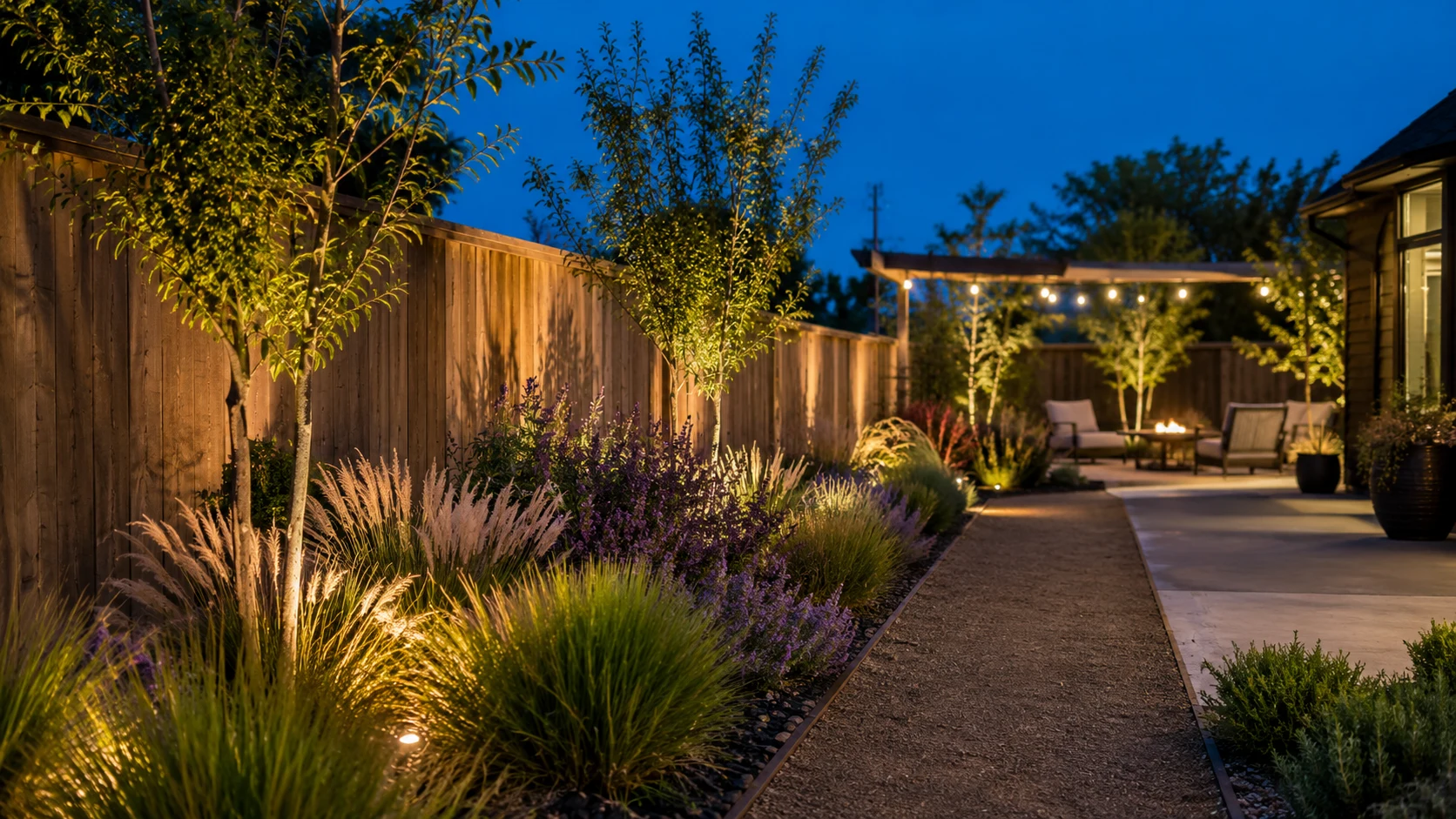
One of the best uses for a hot fence-line bed is turning a hard backyard edge into a better outdoor room.
Imagine a patio pushed against a plain fence. The furniture is fine. The paving is fine. The fence is just... there. A planting bed can change the whole feeling without becoming a giant project.
The move is not necessarily more plants. It is better placement:
- A taller softening layer behind the seating zone, where locally suitable.
- Repeated medium plants that create rhythm behind the patio.
- A lower front layer that keeps the edge from feeling abrupt.
- Mulch or gravel chosen to support the plants, not dominate them.
- Enough clearance so people can sit, walk, sweep, and maintain the fence.
This is where a narrow bed can punch above its size. It becomes the backdrop that makes the patio feel intentional.
The Hot Front-Walk Fence
Another common scenario: a front or side fence runs beside a walkway. The bed is narrow, visible, and unforgiving. Everyone sees the failures.
Here, restraint helps.
Use plants that will not attack ankles, grab sleeves, block sightlines, or flop across the path. Keep materials contained so gravel or mulch does not creep onto the walking surface. Repeat plant groups so the bed reads cleanly from a distance. Use a clear edge if loose materials keep migrating.
For front-yard curb appeal, Low-Water Front Yard Ideas gives the broader entry experience framework.
Vines, Shrubs, And Small Trees: Useful, Not Automatic
Vertical planting can help a hot fence line feel softer and cooler. Vines, larger shrubs, espalier-like forms, or small trees may be appropriate in some yards.
They can also create problems if chosen casually.
Before adding vertical structure, ask:
- Will it damage or overload the fence?
- Will it need regular pruning to stay in bounds?
- Will roots, mature size, or canopy spread conflict with paths, walls, utilities, roofs, or neighbors?
- Is the plant locally appropriate and non-problematic?
- Does it match the irrigation zone?
- Can you maintain it safely?
This article is not a regional plant list or arborist recommendation. For vines, mature shrubs, trees, and fence-adjacent root questions, use local extension offices, reputable nurseries, botanical gardens, qualified landscape designers, arborists, and applicable local rules.
Drainage And Grade: The Quiet Dealbreaker
A planting bed should not send water toward the house, trap water against a wall, undermine a path, or pretend erosion is a design feature.
Keep drainage guidance at the homeowner level:
- Notice where water already flows.
- Avoid trapping water behind edging or against walls.
- Do not use planting as a fix for serious slope or erosion problems.
- Keep soil and mulch from piling against siding, stucco, wood, or fence materials where that creates problems.
- Get qualified help for drainage, grading, retaining, erosion, foundation-adjacent, or code-sensitive situations.
If a fence-line bed has a drainage problem, solve the drainage problem before decorating it with plants. Plants are not tiny civil engineers.
Common Mistakes
Hot fence-line beds fail in familiar ways:
- Treating the bed as leftover space.
- Planting a single thin row of unrelated plants.
- Using too much exposed gravel near young plants.
- Ignoring reflected heat from walls, fences, paving, and rock.
- Choosing plants by nursery size instead of mature size.
- Blocking gates, utilities, fence maintenance, or walking routes.
- Mixing plants with very different water needs in one narrow zone.
- Forgetting establishment care.
- Planting too close to fences, walls, paths, or patios.
- Treating vines, shrubs, or trees as automatic shade fixes.
- Using edging that traps water or creates trip points.
- Expecting a hot bed to look full with no layering, repetition, or groundcover logic.
Most of these are planning problems, not plant problems. That is good news. Planning problems are cheaper to fix before the plants go in.
A Homeowner Checklist
Before building or reworking a hot fence-line bed, walk the area and answer:
- What is the bed's main job: view, screen, patio backdrop, path edge, or service-zone softening?
- Where is the harshest reflected heat?
- How much usable bed depth do you actually have?
- What needs access: gate, fence, utilities, hose, path, tree, or neighbor boundary?
- Which sections share sun and water needs?
- Where can repeated plant groups create mass?
- Where does the bed need a taller layer or anchor?
- Where should the front edge stay low and clear?
- Which groundcover belongs in root zones, paths, and open areas?
- Is drainage simple, or does it need qualified help?
- Which plant decisions need local guidance?
If the bed cannot answer those questions yet, it is not ready for the nursery cart.
FAQ
Are fence-line planting beds harder than regular beds?
Often, yes. Fences and walls can create reflected heat, narrow soil areas, awkward shade, wind pockets, access constraints, and irrigation challenges. The bed may still work beautifully, but it needs microclimate thinking instead of a generic plant list.
Should I use gravel or mulch along a hot fence line?
It depends on the zone. Gravel can look clean and work well in some dry-climate designs, but it can also increase heat and make small plants look more isolated. Organic mulch may be better in many planting zones. Mixed materials can work when each has a clear purpose and edge.
Can I plant vines on a hot fence?
Sometimes, but do not assume every fence wants a vine. Consider fence material, attachment method, mature weight, pruning, irrigation, local suitability, and whether the plant could damage the structure or become hard to manage. Get local guidance for species and maintenance.
How do I make a narrow planting bed look fuller?
Use repeated groups, layered heights, a lower front edge, a middle massing layer, and selective vertical elements where appropriate. Avoid one plant of everything. Also use mulch, gravel, edging, and bed shape to make young plants look intentional while they mature.
Do new low-water plants still need establishment water?
Yes. Low-water plants usually still need establishment care after planting. The amount and timing depend on plant type, soil, season, irrigation method, and local conditions. Avoid universal schedules; use local guidance and observe plant response.
When should I call a professional?
Call a qualified professional for drainage, grading, slope, erosion, foundation-adjacent work, utilities, irrigation complexity, mature trees, retaining conditions, structural changes, local-code questions, or any fence-line planting that could create access or safety issues.
Bottom Line
A hot fence-line bed is not just a place to hide the fence. It is a small, demanding microclimate that can make the whole yard feel better or make every plant look like it is being interviewed under a heat lamp.
Start with heat, access, water, and mature size. Then use repetition, layers, material restraint, and local plant guidance. The goal is not to cram the fence with greenery. The goal is a bed that looks intentional, survives real conditions, and still lets the yard function like a place people actually use.